Pages

Saturday, March 28, 2015

Culture and Crops


"We must celebrate our culture," Ntate Matlakala told me. "You cannot have culture without agriculture as food is a integral part of culture."

Ntate Matlakala is a director of LASTC or Leribe Agric Skills Training Center. He said this as the performances at LASTC's Cultural Day were concluding and we transitioned to dining. I was in attendance because a fellow PCV, Nick, works at LASTC.

Like many of the Basotho there to enjoy the cultural display, we donned appropriate clothing: a Seshoeshoe (Se-shway shway) dress and scarf for me, a kobo or blanket and hat for him. Not only did the Basotho present love seeing us in their cultural dress, but they really cheered when we introduced ourselves in Sesotho during the opening of the festivities.

The event included dancing, singing, musical, and theater performances celebrating Basotho history before we dined on traditional Basotho food made primarily from food grown by the LASTC students.

Instead of sharing this experience in words, I am going to allow the pictures and eventually videos do it for me.

Enjoy!


Saturday, March 21, 2015

Needs Assessment

This week Ausi Mareisi (my counterpart) and I took a big step we had been anticipating since PDM. We held a pitso or community meeting to undertake a Community Needs Assessment.

This is a critical first step before working with our organization to design and implement the primary large project of my service. With more the fifty years in development, Peace Corps knows that without community support even the best projects will not succeed after the volunteer leaves. Therefore, before we undertake our projects, we are expected to do a Needs Assessment to garner that support.

My supervisor and I had met with our chief a week earlier to schedule the pitso. Since CCC (Community Care Coalition) works in five villages, we requested a multi-village pitso instead of conducting five different pitsos. While attendance from the other villages may have been higher had we visited each village, it was far less stressful to hold only one larger pitso. This also prevented people from misunderstanding and thinking I would work with CCC to complete a project for each village.

After living in my village for seven months and spending a lot of time talking to people about needs, it is easy to believe that I have gotten to know the community well enough to understand what they need. At the same time, it is important to ensure that I am meeting their actual needs, not simply perceived needs.

As always, the pitso began with a prayer. Then, with surprisingly little introduction, the meeting was turned over to Ausi Mareisi and me. I started with a five minute speech in Sesotho that my tutor and I had fine tuned over the previous week. I explained that it was time to start a project with CCC, but we needed to ensure we are meeting a community need and have community support. I continued to explain some of the limitations of Peace Corps projects including limited funding and goals from the Lesotho government and Peace Corps that my work must meet. To conclude, I explained how we would complete the Needs Assessment. This was by far my longest speech in Sesotho thus far. While it was not memorized, I delivered it well and only struggled through one tough word.

After my speech, Ausi Mareisi spoke and then we completed the Needs Assessment. First we asked for people to suggest things the communities need. We had a variety of answers including:
  • electricity
  • water
  • a better road
  • a speed hump on the district's main road where the school children cross
  • a “sawmill” (what the Basotho call a sawmill is actually a grist mill to grind maize and sorghum into powder for cooking)
  • income to help provide for orphans, vulnerable children, and the sick—this one took on a variety of answers...
    • money to buy chairs to rent out with the community building to generate income
    • reinvigorating the CCC vaseline project
    • getting milk cows
    • getting egg laying chickens
    • making soap to sell
    • training to make and sell shoe polish
  • increased food security
  • job creation
  • more toilets
  • better clinic access
We then allowed people to vote for only two items, however, every single person immediately voted for the first item: electricity. Thus, we adapted and allowed them three votes. This narrowed our list down to five needs: electricity, speed hump, job creation, food security, and income to help OVCs.

From there we completed what is called pairwise ranking, comparing each item against each other item. Despite everyone voting for electricity in our first vote, when compared with money to help OVCs and food security, it took second billing. When compared with jobs, it only tied.

It was challenging to convince people to choose one out of two things they see as strong needs. The meeting nearly fell apart when we asked them to choose whether increased food security or money to help OVCs was more important. It took a lot of energy to get things back under control and moving again.

In the end, the community strongly placed income to help OVCs and the sick above everything else although increased food security and job creation were also important.

The planned outcome of this pitso is to use the information when we meet with CCC to plan our project. 

The unplanned outcome has been the conversations this has sparked with villagers in the last three days. Those that did not attend the pitso have started many chats about the pitso and community needs. Just like the people at the pitso, each person has immediately said that we need electricity, water, and a better road. I agree with them but then try to explain in Sesotho how the community reached the decision that money to help OVCs was more important than electricity.


Another outcome has been the affirmation that I do in fact know my community. The types of projects I have been considering and even the one that Ausi Mareisi and I designed for practice during PDM match with two of the three things that villagers ultimately said were most important.  

Friday, March 13, 2015

Mokete ea Temo

Or, Agriculture Party...

In the late 1980s, my village started an irrigated agricultural scheme. Instead of each villager working alone to grow crops to feed their families and then maybe a bit extra to sell, they combined their efforts. Not only do they share the work and successes, but they now buy their seed in bulk, sell in bulk to shopkeepers as far away as Maseru and Mokhotlong, and as a group own a few pieces of farm machinery making their efforts more efficient.

While much of the money goes back into the scheme and to the families owning and working the fields, some is also used to support school fees and supplies for orphans and vulnerable children in the community. Recently, Letseng Diamond Mines agreed to give greenhouses and fencing to the scheme to help it continue to grow. These are currently being erected at the scheme's farm building.

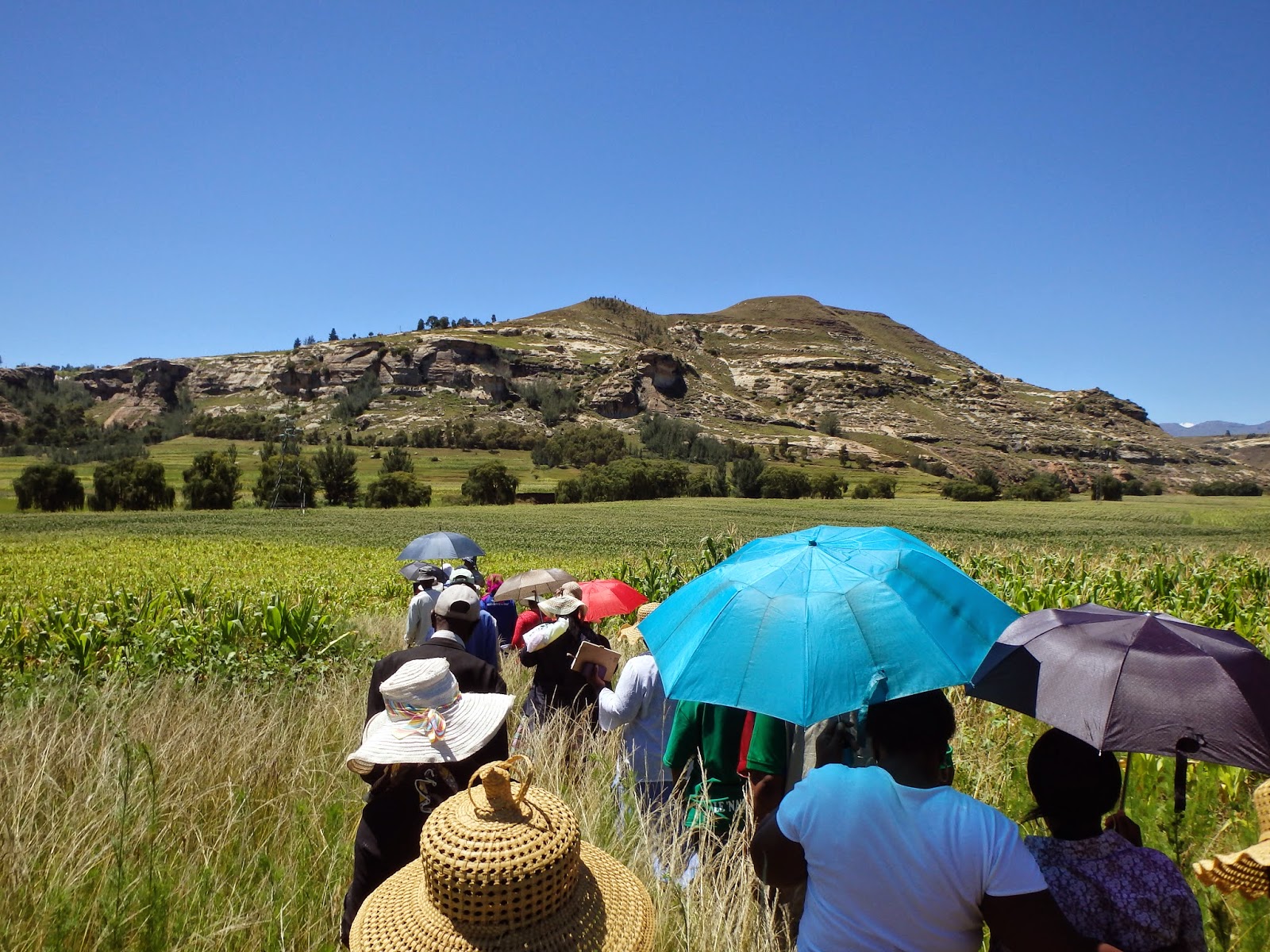
This agricultural scheme and our current maize (corn) crop is so successful, that the local Ministry of Agriculture sponsored a mokete or party to both celebrate their accomplishments and record their activities to share with other communities.

Blending in with the maize in my Seshoeshoe.
As a result, I found myself donning my Seshoeshoe (se-shway-shway) dress and prepping for a party early one Wednesday morning. I was being blessed with a ride from the village to the fields where their party was to happen; thanks to the Ministry of Agriculture and the women who were responsible for cooking the food for the party being my neighbors. I had been told we would leave at 8 since the ceremony would begin at 9.

By 9:30, I began to worry that maybe I had been forgotten despite knowing the Basotho propensity for lateness and having not heard a car in my area (We are really far removed from the main village roads so car sounds are noticeable). I grabbed my stuff and headed over to my neighbors, relieved to find they were still cooking.

We hung out, snacked, sang, and chatted for two hours while they finished cooking. Finally it was late enough even they wondered where the car was. A few phone calls later and the Ministry truck was on its way. We piled in and as we drove out of the village with a truck full of excited women, they shrieked and blew whistles so everyone would know we were headed to party.

The ceremony started almost as soon as we arrived, because I was special enough to arrive with the fifteen women that were the party. We opened the traditional way; with a song and prayer. Then, we were brought on a tour of some of the fields with stops to discuss the seeds used, planting and weeding times, and other aspects to the growth of the crops. Throughout, a man from the Ministry videotaped the speeches, questions, and answers. 

When we returned to the tent, we sat through over an hour of speeches celebrating the work of various individuals, the group as a whole, and the like. Much of it I understood, although bits were in terminology far exceeding my vocabulary. There were breaks for song, as they are a critical part of any celebration. 


After the ceremony, we enjoyed nyekoe and motoho. Nyekoe (Ni-eck-way) is a local dish made of beans and sorghum. Extras that can be included are meat, vegetables, and various seasonings. I love it! Motoho is like the sourdough bread of sorghum porridge. It is another local favorite of mine.

It was a lovely party. I enjoyed being with so many of the energetic people from my village throughout the day.  

Follow up to this is available at Mokete ea Temo: Celebrity Style.

Monday, March 09, 2015

Lesotho Elections

Regular readers will remember that Lesotho had an attempted coup at the end of August, which led to all PCVs spending an anxiety-riddled three weeks in South Africa (see Consolidation Vacation and Consolidation Continues). Thankfully, things settled down though the same agreements that allowed us to return to our homes called for elections in February 2015.
Campaigners dancing at the gas
station on their way home from a rally.

As a result, the new year has been filled with a sea of brightly colored Basotho campaigning in villages, towns, and especially Maseru. As early as Christmas, people on taxis asked me if I would be voting, who I supported, and what I thought. My answer was always the same as I explained that PCVs are not allowed to be involved in local politics or share opinions on local politics.


As the election loomed, PCV chatter centered around how it may impact our service. In 1998, PCVs were consolidated after riots broke out in Maseru in response to the election outcome. South Africa sent in security forces and people died. From what I have heard, the political climate leading up to the 1998 elections was less tense than it has been since June when the Prime Minister dissolved the parliament. As a result, we all wondered what Peace Corps would do and whether we would again be living the not-so-dope hotel life.  

Thankfully, that did not happen. For the days surrounding the election, we were expected to lay low in our villages, but to continue with normal life while avoiding polling places and large gatherings. This was incredibly easy to do in my village, especially since it ended up being a very gray and rainy set of days, which pretty much changes normal life to staying home for most villagers anyway.

My brother showing off the mark that he voted.
As a nineteen year old, this was his first time voting!
After the elections, conversations around the village centered on the results. Starting the evening of the election, people spent more time around their radios, responding loudly whenever a positive announcement came in for the party most favored in the village. Through the night and into Sunday morning, I could hear people's reactions from my own hut.

More official announcements came in throughout the week, showing the party of the Prime Minister with a slight lead over the party of the previous Prime Minister, whose party had been in control until the Prime Minister's party managed a coalition to take control in the 2012 election. This had my villagers thrilled. But, the previous Prime Minister learned and in the end was able to take control in the same manner as he had lost it, forming a coalition with a number of parties to just barely secure a majority in parliament and therefore return to being Prime Minister.

This was announced late in the week. As I traveled for a committee meeting over the weekend, I was reminded of sports fans following a championship game—people in the parties that formed the winning coalition were decked out in party gear throughout the five districts I passed through. The level of enthusiasm for the election far outlasting any political engagement I have seen in the United States.

Those who supported the outgoing party seem to be taking things well, expressing joy that the process was peaceful rather than their disappointment in not winning. That said, they still have a large representation in the new parliament and can celebrate having taken far more voting areas this year than in previous elections.


Similarly, we PCVs are celebrating the fact that the election process has been far more peaceful than it could have been. I have never been so happy to say I did not travel!

Friday, March 06, 2015

Peace Corps Week 2015

I had big intentions for Peace Corps Week 2015. I was going to pre-write and auto-post a new blog for each day, highlighting a different aspect of Peace Corps history, Peace Corps life, and Lesotho.

Instead, life got distracting. I did not have time while in town to find the nuggets of awesomeness I was going to share. After nearly a month with little rain, we had only gray skies and showers for four days, making it impossible to use my phone to follow through. (Sun = power)


Enough excuses though. It is Peace Corps Week. Peace Corps, like some of my friends, sees its birthday as cause for a week of celebration. I, for one, agree. The reality is that Peace Corps has done so much in its 54 years that one day simply does not do it justice!

For example:
  • As of 2008, 961 PCVs has published books after their service. (“Did You Know: 25 Peace Corps Fun Facts")
  • The oldest PCV to date was 87 when he completed his second service. (“Did You Know”)
  • As of 2008, there were 224 languages spoken by PCVs. (“Did You Know”)
  • Nearly 220,000 Americans have served as PCVs in 140 countries. (“Fast Facts”)
  • There are currently just under 7,000 PCVs in 64 countries. 45% of them are with me in Africa. (“Fast Facts”)
  • In 2014, Peace Corps unveiled a new, faster, and more streamlined application process. While applicants are still encouraged to be flexible, they can now apply for specific jobs in specific countries. When I applied, we simply said, “I want to serve.” I had no real say in where or what I would do as a volunteer. I had not even heard of Lesotho before I received my invitation in October 2013!
  • Twelve current African presidents say they got their start because of interactions with a PCV in their country! (Georgetown)

But Peace Corps is more than just statistics and little tidbits. Peace Corps is a unique approach to helping the developing world. We are not the only volunteers representing our country, other countries send volunteers to developing nations as well. We are not the only United States-funded program in the developing world. We work alongside the US Embassy, US AID, and many more government funded programs. But, at least in Lesotho, we are the only ones living life alongside the local population.

The Peace Corps approach does not use quick fixes. When we arrive in our sites, the first six months of our time is spent getting to know the people and the local population. We are not allowed to start projects until we have been in our community for half a year! Even when we do start our projects, there are steps we must take to ensure we are meeting a need the community recognizes and wants met instead of simply doing what we think is best. Our projects are not really “our projects,” they are the community's projects and we are simply helping the community complete said projects. We are, for the most part, a source of education, training, inspiration, and ideas, not a source of money. The goal is that when we leave our community after two years living like and working alongside the local population, they will be able to continue our work without us or outside money. Our job is to be not only replaceable but unnecessary over time.


And that is what makes Peace Corps different than others working in the developing world. Because we are bring capacity building instead of cash, our work can continue to impact long after we leave.  

Tuesday, March 03, 2015

"Casualty"

Since PDM, life in the village has been busy! I have been everywhere from school visits to clinic day. Last week, as I was walking home from a school, I caught my foot on a tree root.

The root snuck between my Chaco and foot, attacking the soft space where toes meet foot. It smarted a lot, but I disengaged and kept walking; laughing at my klutziness and ability to stub my foot instead of my toe.

As I walked, I could feel it bleeding. My WFR [Wilderness First Responder]/Ship's Medical Officer habits kicked in and I developed a plan to prevent infection. I got home and immediately filled a basin with boiled and filtered water to soak my foot. It still hurt more than I thought it ought to.

Finally, it was time to survey the damage. With my headlight (my hut is dark in the afternoon), I found a nice cut...and a few chunks of wood and bark in it. I used tweezers to remove most of them, but the largest one would not move. It was set a few millimeters from the cut and was pointing straight in (or out, depending on your perspective). No matter what I did, it would not move.

It was time to call PCMO [Peace Corps Medical Officer]. After sending some photos and two phone calls, PCMO decided I should go to the local emergency room as a trip to see her in the capital was too far.

I bandaged myself and tried to put on sneakers for the dusty 2 km walk to catch a taxi. That was not an option, increasing the pain too much, so I chose to be highly fashionable in socks and sandals. I realized as I left my house that I had only 90 minutes to get to the hospital before they closed for the day. The trip usually takes over an hour.

Thus, I found myself trying to ignore the pain while speed walking through the donga. Thankfully, I got to town in under an hour. A friend was in town and met me at the hospital.

Despite being there monthly for a teen HIV+ support group, I had not idea where to go as a patient. The Butha Buthe hospital is government run. It is comprised of nearly a dozen one-story buildings, most of which are labeled. I asked the security guard where to go and she walked us to the nearly empty outpatient building.

The only person we saw as we entered was a woman mopping the hallway. The security guard has us sit on a bench in the hall. A few minutes later, the woman mopping has us move to a bench further down the hall before she disappeared. We spent a few minutes alone in the empty hallway chatting as I tried to ignore my anxiety about it being near closing time and empty.

A door labeled Meno (teeth) opened and a friendly man greeted us, making sure we were not waiting for dental care. Then, the door next to us opened and an nkhono (grandmother) shuffled out. The man we had been talking to smiled and told us to go in the room she had just left. It is a good thing he was there to instruct us after decades of American medicine have taught us to wait until we are called.

We entered, going through the proper greetings before I explained my problem to the woman at the desk. She immediately told me we were in the wrong place and needed to go to “Casualty.” She pointed in the direction of most of the hospital and told me it was there.

Following her directions, we found the Adolescent Corner (a building I know well from work related visits), Administration, and X-ray but no emergency or casualty. We stopped at X-ray and asked for directions to the unmarked emergency department.

Once there, we had to wait a few minutes as the two staff-members present finished discharging a boy with a broken arm. The, we were the only ones there. We entered the office, greeted appropriately, and I explained the problem again. PCMO had been explicit as to what to say to ensure only sterile equipment was used without being offensive.

One of the two staff then took us into a treatment room. My friend, who used to work in a hospital, later compared it to something out of The Saw. It had two patient tables as well as a table with a pile of loose gauze and forceps, and another with various medical supplies. I took off my bandage and tossed it into the open, nearly full 20L bucket marked Bio-hazard.

The man, who I later decided was a health worker as he was not in a nurse's uniform, looked at the foot and grabbed a pair of forceps. Without preamble or touching my skin, he latched the forceps onto the wood and pulled. The forceps slipped off a time or two, but he successfully removed the wood as the doctor walked in. The doctor looked at the wood and my foot, saying, “good,” before turning around and walking out.

My foot was then dressed with what looked like an iodine ointment and burned like putting Ben-gay in someone's eyes, gauze, and athletic tape. We returned to the office to speak with both men about billing and further care. This, it turned out, took more than twice as long as the actual medical care.

In Lesotho, patients keep their own medical records in green or yellow books, called bukana ea bophelo or book of life. Yellow books are for children and green for teens and adults. I am familiar with these books as I record infant and toddle weights in yellow books each month at our village clinic day. Having never received medical care in Lesotho, however, I did not have a green book.

First, we went back and forth about how they could prescribe antibiotics without writing the prescription in my green book. The doctor ultimately wrote the two prescriptions on another piece of paper. Then, I asked how to pay for my medical care and we went back and forth again. It sounded like the doctor thought that without a green book, it would be best if I simply did not pay because the administrative staff only know how to bill with a book and I thought I could probably get the medications from Peace Corps instead of the hospital pharmacy. The health worker simplified things by asking if I had 15 rand. I did, so I bought a bukana ea bophelo.

The doctor wrote out the  shockingly brief record of my visit:
“Foreign body in the foot
Extracted and dressing applied.”

The health worker than walked as to a partially open window outside the Administration Building. Before stepping up to the counter, I called PCMO and confirmed she wanted me to take both antibiotics. She insisted upon them and gave me additional care instructions in far more depth than the hospital doctor had.

I stepped up to the payment winder and paid 30 rand (less than $3 US) for the medical care and two prescriptions. I was given a receipt and we headed to the outpatient building where I thought I had seen a window labeled pharmacy. I was thankfully correct.

At the pharmacy window, the receipt and two prescriptions in my green book were checked off. I was given two bags of pills with instructions about when to take each. These medications in these dosages must be prescribed often as there was no wait. The pills were pre-packaged in the correct quantity to fill my prescription immediately.

As my friend and I walked past the hospital gate, I thanked the security guard for her earlier help. I glanced at my walk and realized the whole experience had taken only 35 minutes and we were leaving ten minutes before the hospital was to close.

Since it was now four and neither of us had eaten lunch, we went to our favorite local food location in Butha Buthe. My friend then bought me ice cream—everyone deserves a treat after visiting the hospital, right? I joined him for the food shopping he had put off to participate in my medical adventure. Then, we headed to our respective taxis, villages, and homes.

While in town for those two hours or so, I had bumped into seven different people I knew and even managed to schedule some future work with one of them. My taxi, as is often the case on the last run of the day, was heavily overloaded. Squished in between three men, a mirror, and a few 80kg bags of maizemeal, I reflected on my “casualty” and consequent adventure.

Although walking out of the village with a chunk of wood in my foot was pretty uncomfortable, I am grateful I had enough time to get it taken care of and get home before dark. (Peace Corps asks us not to travel after dark and my walk home from the taxi stop is pretty treacherous in darkness.) I am glad I could take care of this silly problem locally instead of traveling 4+ hours to Maseru and having to spend the night. I feel incredible blessed to have the kind of friends who will give up valuable town and internet time to join me at the hospital. And, to be completely honest, I am really grateful my injury was not something more serious being treated in the local hospital.

Once home, I shared the story with my brothers before we sat down to finish watching How to Train Your Dragon on my tablet.


If you're squeamish about blood and cuts, do not scroll down! But, if you are one of my many friends who loves medical stuff, here's my little injury after I had cleaned it up. The lighter colored thing is the piece of wood that would not budge.