Featured Post

U motenya!

I leave my house for work and get called over by two village women awaiting their chance to do business with the chief. The first smiles...

Showing posts with label Basic Needs. Show all posts

Saturday, May 26, 2018

Note to Self: Peace Corps Lesotho Edition

I recently saw an interview of Gayle King on The Daily Show about her new book, Note to Self: Inspiring Words from Inspiring People. The book is based on letters to a younger self that people, mostly celebrities, have been asked to write. I was inspired to use the concept to reflect on my own growth and experience living abroad in Lesotho as a Peace Corps Volunteer for the last four years. So here goes:

Dear 2014 Beth, 

You are about to embark on an incredible experience. Stop worrying about what you are going to pack and stop wasting money on clothes to last you for the next two years. They literally sell clothes on the street in Lesotho. Do not fret about the investment in quality footwear though, you will wear out four pairs of shoes in the next few years. Also, the solar panel is a brilliant investment.

Instead, keep doing what you are doing. Maximize your time making memories with family and friends before you go. Invest in them as those relationships will sustain you through more than you imagine in the next few years. You are about to experience more happiness and pain than you knew was possible.

Just a typical day in Ha Rasekila at work with the
women in the community group.
You are worried about loneliness, feeling like an outsider, and isolation. You are going to let this fear motivate you through long language lessons. Even after you have a passable command of Sesotho, keep studying and learning. You will never regret taking the time to learn and practice the language. It is one of the greatest ways to show respect, bond with people, and to be professionally effective.

When you finish training and it is time to buy things for your new home, please buy the kitchen table you dream of. Do not let anxiety about surviving on the small Peace Corps living stipend keep you from this splurge. You will want that table for longer than you initially plan to be in Lesotho.

People will wonder at how you live without running water or electricity. In reality, going without those things is not what makes Peace Corps challenging. Spending money on data for Whatsapp calling and voice notes is always worth it. This is not a travel adventure. You will spend twice as long removed from your American family and friends as anticipated. Maintaining those relationships is worth the absurdly small investment in data bundles.

Remembering to stop and enjoy the goofy moments of life
with my great friend Luwi. 
Despite all the warnings in mandated Peace Corps security sessions, most Basotho are only interested in talking to you and welcoming you. Do not be stupid about your safety, but do not close yourself off either.

You will be in Lesotho a long time. In the end, your closest friends and supporters will be the host country nationals you get to know. Invest more time and energy in those relationships sooner instead of in the comfort of American peers.

Drinking Ricoffee (instant chicory root coffee) for the first six months is not worth the savings. Stock up on filter coffee that one time you shop in the capital. It is not integration to deprive yourself of this small luxury.

Take more photos of the everyday moments of your life and fewer photos at events. Some day you will return home and want to share the mundane aspects of life with people.

Trips home to visit family and friends are always worth the travel time, jet lag, and money. You will get to meet your infant goddaughter, see your ailing father, and keep relationships strong even after you decide to double down your PC service. Learn from the Basotho culture and put people first when your friend calls to announce and celebrate her engagement, promise to attend the wedding right then instead of changing your mind six weeks before the wedding.

Your house will be your comfort zone and break from the challenges of living in a foreign language and culture, but get outside of it! Walk around the community and greet people, go to community meetings and events, do your chores outside. Loneliness is of your own making. There are a ton of people just outside your door eager to welcome and befriend you. With time, your community will become your comfort zone. After you move away, returning to see them will be the best homecoming you can imagine.

My Basotho family has been a huge part of my life and
experience. I am so blessed to have been welcomed
into their lives.
Never fail to appreciate the moments people invite you into their family or cultural traditions. Such love and welcome may come at bad times or with expectations, but it is such an incredibly unique honor.

You will spend a large part of the next four years being uncomfortable. In your first year, it will feel like a great adventure even if some days, you will lose the battle and hide in your house. Although you will gain experience and get used to a lot of things, even after four years, you will still have moments that you have no idea what is going on, what someone is telling you, or what is expected of you. That is just the reality of life in another culture. Embrace it because those uncomfortable moments often open you up to some of your greatest experiences. You are not moving around the world to be surrounded by the familiar and easy.

Right now, you have days that you question whether you are doing the right thing by moving around the world for two years. When you receive your Sesotho name from your first host family, you will be reassured that you are where you belong as they explain in great depth that your new name means "God's will." You will question everything again during your first extension when you are blindsided by incredible loss and, ultimately, you will recognize that every step of your life's journey was leading you to Lesotho.

With the two men who have had the greatest
influence and impact on my life in Lesotho. 
In the next four years, you will develop such strong bonds with new friends and family members that you will question how you survived over thirty years without these people in your life. You will spend more time alone. You will learn just how much American culture influences your own thoughts and reactions to the world around you. You will fall in love with so many aspects of Basotho culture and with so many people.

In four years, when it is finally time to return to America, you find yourself right back where you are right now. You will wonder if leaving home and going to the US is really right path for your life. Have faith. In another four years, you can write yourself an updated version of this letter. It will, undoubtedly, be full of reassurances and growth. Until then, embrace people and experiences. Make the most of every moment.

With love,
               Thato, 2018

Monday, November 07, 2016

Chicken Coop Construction: COMPLETION!!!

Chicken house completion has finally happened...although two months became more than four, the house is completed and ready for the arrival of MCCC's 200 egg-laying chickens!!
The burglar bar completion finally happened a week after the third business owner gave me a quote. His staff was incredibly professional and efficient when they came to do the installation. They even helped fix a burglar bar on our hall while they were there! 
Burglar Bar installation-I had to see it to believe it!

The next week I had a momentary panic when the man we bought the chickens from called. When I ordered the chickens, he said the delivery would be happening in September. We were into the second week of October and still needed to finish the cages and buy chicken food. Before I answered, I was sure he was calling to tell me the chickens had arrived. Instead-to my great relief-I learned they would be arriving at the beginning of November! 

Ntate Tau adding drinkers to the chicken cages.
Over the next three weeks, every moment that I was not away to assist with Pre-Service Training for the newest members of Peace Corps Lesotho, I was working with Bo-'M'e to ensure we were ready. Ntate Tau, our chicken cage designer, returned a few times to install the chicken cages. His workdays were some of the most fun as we chatted extensively about numerous topics while he worked.

Monday, October 31, 2016

Hardship Hits Hardest at Home

My suddenly very adult brother,
Abuti Thabo, at the mine. 
I stare at the screen of my phone and blink back tears of frustration and anger as I reread my brother's text message: "I miss you too my sister. I don't think I will come for writing [my exams] because they are disallowing me to come write."

One week before receiving this frustrating text, I had been sitting in the hall at my brother's school; beaming as he received the Leadership Award. Now, I am sitting in that same hall doing Camp BRO. I am forced to be on my game-inspiring young men to be positive leaders for social change-when all I want to do is mourn the future I imagined for my brother.

My amazing and inspiring brother will not be completing secondary school at the end of November as planned. He will not be writing the intense Form E exams to earn his certificate—the Lesotho equivalent of a diploma.

Instead, he is now an employee at a platinum mine in South Africa; taking on the job his father held before his untimely death a decade ago due to “mine-related illness.” Because the mine acknowledged responsibility for his illness, they have been holding a position for my brother for the past decade.

Thursday, September 29, 2016

Three Photo Thursday-29 September

Back in January, one of my villagers began construction on her huge house. I mentioned it at the end of Constructing Dreams. For eight months, the walls sat, completed, waiting for the roofing process to begin. To roof a large cement block house like this first involves building up the walls anywhere the roof will by high, before actually attaching the roof.

I had begin to think I would not see the house completed, however, this week the roofing supplies arrived and workers began the roofing process. Here the workers are adding the cement bricks that will support the roof on their first day of work. 


Although harvest in Lesotho was months ago-in July-much of my family's maize is still sitting on the cobs waiting for my host mother to have time to remove it. She is simply too busy with work, caring for the boys, and church to also spend hours separating the dried corn from the cobs.

This week, however, my nkhono or grandmother came to help as the family needed to grind more maize into powder for papa.  She spent two days just sitting in the shade working away-occasionally yelling at the pig for trying to come and sneak some food. It was great to have her visit and a boon to my mother to have the help around the house.


Over the course of the political primary, many Basotho would ask me about the American election and when I would be returning to vote. Having watched a number of villagers who work abroad return home for their own special election in February 2015, their question made sense to me. In order to avoid voter fraud, Basotho must vote in person.


Those conversations have highlighted for me, yet again, how lucky I am to be American. Obviously, I would not be a US Peace Corps volunteer living in Lesotho if I were not American, but, that aside, I am able to vote from Lesotho with little hassle. I signed up for my absentee ballot early on in the primary process (although sadly, not early enough to cast my ballot in New Hampshire in January). From there, I simply waited until my town clerk emailed it to me. Forty-eight hours later I found myself researching the New Hampshire gubernatorial candidates and presto, I have voted…five Tuesdays before America goes to the polls. And, since there is no postal strike in South Africa this year, unlike in 2014’s election months, my ballot should make it home and get counted! 

Monday, September 26, 2016

Making RUMPs

Sewing and posing all at once-a perfect Saturday afternoon!

I had only been in my village a few months when I noticed a girl in my neighborhood was at home one Monday. She was actively doing chores around the home, but she should have been at school. I asked why she was home and she smiled, telling me she was sick.

I was confused, as she appeared to be perfectly fine. We had the same conversation for another two days, with her still looking perfectly well. The fourth day, she was back at school. 
When I noticed her home again a few months later, I took advantage of my improving language skills and asked more questions. I learned that she was home because she was menstruating. As a single orphan (in Lesotho, single orphans have lost one parent, double orphans have lost both) with a father who works outside of Lesotho, she had no access to menstrual hygiene products and realistically, no money with which to buy them. 

This troubled me until I attend the LGL Summit in June. There I learned an inexpensive and easy way to RUMPs or Reusable Menstrual Pads. Since then, the women in my organization and I have been planning a time to make these with both women and girls in my community. 
One of the things I love about this particular pattern is it does not require special skills or materials. It uses only fabric, towels or other absorbent material, thread, a needle, and a button. The fabric and towel do not even have to be new, just clean, making it the perfect project for people with limited resources. 

The women of my organization and I have been planning this day for a few months, scheduling it for after most of work with the Chicken Coop Construction would be completed. Girls were asked to bring their own fabric, however, I supplied the other sewing materials thanks to my mom and RPCV Lisa supplying me with more sewing notions than I could ever use. 
Finally the day arrived and the fun began!

Step One:

Trace the pattern onto the material and cut it out. You need to copies. 

Step Two:

Hold the two cut pieces together, pretty side in. Place ribbon or material sewn into a strip near the top and bottom of the pad. Pin everything in place. 

Step Three:


Sew the two pieces of fabric together, but stop with a few centimeters not completed. Turn the work right side out and finish stitching. 

Step Three is best done with friends, conversation, laughter and music!

Step Four:

Sew a button on to one wing of the pad and a button hole on the other wing. 

Step Five:


Show off the completed work. The middle pad currently holds towel, to show how
these beautiful works of art with in fact work.

Posing with a pad-pride in accomplishments
and empowerment!
Strike a pose and show off your girl pride!


Tuesday, August 23, 2016

Chicken Coop Construction: Weeks 5 and 6


Construction Completed!!
Week Five: We have completion! Well, construction completion anyway. Although the house is not yet ready for chickens to arrive, the roof is completed and well secured for its windy locale. Although I missed watching the team finish the house, I learned of their accomplishment before boarding my taxi to come home. Multiple people in town stopped me in my tracks; thrilled me to tell me that the chicken house was done and beautiful.

As my taxi crested the hill before our building site, I caught me breath eager to see the completed project. It looks wonderful!

Week Six: When week five started, a friend helped me schedule someone to install burglar bars in the house on Sunday of week six. In my head, with burglar proofing happening Sunday, the cages would also get installed this week.

Clearly I should not develop expectations, even when things are scheduled and we have asked a million clarifying questions in two languages.

When the man building and installing our burglar proofing arrived, we were all stunned. He was shocked to learn we do not have electricity in our village. Bo-‘M’e and I were equally blown away that he never mentioned needing electricity to complete his work.

As PCVs, we are supposed to work with host country nationals in all things. This is to build their capacity to do the work after we return home. In this case, I am grateful to have worked alongside women in my organization as otherwise I would have feared my language skills caused the confusion and delay.

Still waiting for burglar bars on these windows, but wow,
that roof is pretty!
One of the leaders in my organization and I had spoken to this man twice in person. The first time was when we were getting a quote for building supplies and pricing. He looked at the printed list of supplies and said we had everything we needed listed and priced his work. The second time we spoke was on the day that we bought the building supplies. Again, we checked to ensure we had everything as we did not want to have to hire a vehicle for later deliveries of building supplies. Again, he confirmed we had everything and he gave us his contact information.

I have an incredibly hard time understanding this man’s Sesotho, so it is possible that I would have missed any mention of electricity despite knowing the word. I was, however, working alongside ‘M’e ‘Majustice and a woman from the building supply store. ‘M’e ‘Majustice knows that we do not have electricity in our villages. She would have quickly jumped in had he suggested anything connected to moltakasa or use of a generator. I do understand her Sesotho. The woman from the store translated many of his words into English for me and I am certain this important fact would not have been ignored as much of our district does not have electricity.

As a result of this miscommunication, we spent two hours trying to find a generator for the following week. His job at the building supply store makes him only available to do the work on Sundays. He made it clear that we needed a large generator. When he looked at the first one we found, it was too small. We went to another family’s home to see their larger generator. Although larger than the first, it too was too small. Then he clarified the power of the generator we needed-double the first one we had looked at. As we walked back to my supervisor’s, I expressed concern that we may be unable to find one that large as our village does not have people rich enough to have such large generators and we do not have the money to rent one from somewhere else.

Before he departed for the day, I asked him to take a look at our supplies again, just to be sure that if and when he returns we actually have everything needed to do the job in one day. It turns out that we are missing square “tubing” to serve as the outside of the burglar door frame. We need to buy two sections. Apparently, checking the list when we were at the building supply store on two separate occasions did not highlight this important missing piece. Buying these now will require hiring a truck as they are too long to strap to the top of our taxis.
One of the women in my organization poses with the
completed chicken house before our meeting.

So now we have to figure out how to find a huge generator, buy oil and petrol for it, buy the two sections of square tubing, and hire a vehicle to deliver the tubing or we have to find a new person to do the work; one who can arrive with and by his own power. This lack of clarity looks to more than double the anticipated cost of burglar proofing the chicken house in addition to slowing us down.

Despite my frustrations with the man who was to do the work, I am surprisingly unfazed by the situation. Obviously, my expectations are shifting and I am becoming more accepting of the twists and turns in the project.

Bo-‘M’e and I visit numerous houses in multiple villages trying to secure a generator large enough for the project. We are unsuccessful, however, my visit to town to get new quotes from people with larger shops gets us a few reasonable quotes that come complete with transport, installation (including bringing their own generator), and the supplies. As predicted things will be twice what we estimated, but a careful look over the budget and remaining funds reassures me we can still afford this vital step in our project. 


MCCC’s Egg Laying Chicken Project has been in development since March 2015. After many delays, MCCC and I were able to write a successful grant proposal for a VAST grant through Peace Corps. VAST grants are funded by PEPFAR to help with HIV-related work and OVC (Orphan and Vulnerable Children) care. It is due to MCCC’s work with OCVs that qualified us for the VAST grant. Otherwise, we would have applied for a PCPP [Peace Corps Partnership Program] grant and would have been asking for assistance in funding this grant proposal. I encourage you to consider supporting other PCPP projects.

Posts about this project include:

Friday, July 22, 2016

Chicken Coop Construction Day Five

The written plan for the chicken house.
The walls are done. The guys finished the third wall in only two hours, before tackling the windows on the back wall.

They decided not to use the lintels we bought to go above the door as the steel doorframe will provide enough support for the bricks above the door. They then humored me into adapting the plan for the back windows. Instead of three equally sized 0.7 meter wide windows, we now have two 0.7m windows framing a 1.3m window.

Give than chickens need ample sunlight in order to lay well, I am excited by the new plan. We will end up two 0.9m lintels leftover, but at least that is less wasted money than if we did not use the larger ones.

Since I will be working my PCVL role with Peace Corps while the guys finish the roof and floor, Abuti Sama and I took a few minutes to go over the location of the supplies. When I return from facilitating an In Service Training for other volunteers and their counterparts, construction will actually be done!


From there, we will arrange for someone to burglar proof the windows and door. The cage builder will return to finish things. Then, we go to the Ministry of Agriculture to order our 200 chickens.

Before the chickens arrive, which can take up to two months, we have a few other things to do. Although we have already done initial business and accounting trainings, we are going to do more specific budgeting training. It is vital that the women in MCCC budget and save to buy feed and medicine every three months as well as new chickens annually.

Goofing off with my brother Thabo on the job site.
I would like to see them plan ahead as to how they intend to use their income in helping the OVCs [Orphans and Vulnerable Children] in our community. Ideally they will do so proactively instead of reactively. I am relieved to be staying at this site for the first quarter of my third year to help make these things happen!


MCCC’s Egg Laying Chicken Project has been in development since March 2015. After many delays, MCCC and I were able to write a successful grant proposal for a VAST grant through Peace Corps. VAST grants are funded by PEPFAR to help with HIV-related work and OVC (Orphan and Vulnerable Children) care. It is due to MCCC’s work with OCVs that qualified us for the VAST grant. Otherwise, we would have applied for a PCPP [Peace Corps Partnership Program] grant and would have been asking for assistance in funding this grant proposal. I encourage you to consider supporting other PCPP projects.

Posts about this project include:

Thursday, July 21, 2016

Chicken Coop Construction: Day Four

“E felile” (aye fay-dee-lay) the grandfather of half the work crew says after lunch. Throughout the afternoon, as building continues, various people walk by repeating that same statement: “E felile,” or “It is finished.”

As Day Four closes, two sides and all four corners are completed. The walls will be done on Day 5. It is nearing completion, but it is not finished.

The morning and early afternoon were centered on the front face of the building. The guys’ fast pacing slowed due to the transitions to scaffolding and windows.

With only two men able to build at a time, the guys on the ground had more idle time to distract themselves. This gave me even more opportunity to jump in; lifting bricks above my head to my friend on the scaffolding.

The laid back attitude of the builders surprised me. Just as they finished the brick layer before the windows began, I asked how many bricks high the window openings would be.

Apparently in all our planning discussions, this never came up. I had been assuming they would be three bricks high while my friend was envisioning them as two bricks tall. He promptly removed bricks he had just cemented with no sarcasm or irritation. I expected at least a trace of annoyance but there was none to be had, reminding me how Basotho culture is incredibly accepting of things happening differently than planned or expected, especially compared to American culture.

The windows really slowed things down as nearly every brick surrounding them had to be cut just so in order to fit. While Abuti Sama trusted the other guys to split the half bricks by the door, he clearly did not have the same level of faith for the specific ones needed by the windows. He carefully measured and split bricks in half horizontally and took out perfect corners, all without wasting a single brick. His experience is obvious in all his efforts, as is that of his cousin (the other primary builder).

I cannot help but laugh at the expectations I awoke with on Monday. Day Four is done and we still need one more full day to do the walls, another two for the roof and floor. My expectations were not of my own making. I was told a week at most including the roof and floor. But, when Abuti Sama built his house, which is larger, they had the walls done in 1.5 days. Why did this “simpler” house take longer?
                1) It is winter. Abuti Sama built his house six months ago when the community and sun are awake at four am and dusk is at nine. Right now, the sun rises at seven and sets at six; making the workday five to six hours shorter.

The guys bring bricks uphill from the community building
to the building site, 5-7 at a time.
                2) The team…It was a team of five to seven experienced friends who were all home for the holidays who helped with his house. The process, with such experiences guys who are used to working together, is understandable faster than two experienced guys with five helpers to assist with moving bricks and mixing cement. Our team has been great, willing to work long and hard for their breakfast and lunch, but they are slower than the well-greased team he built his own house with.


Bo-'M'e watch the men working, thrilled to see the chicken house "finished".

MCCC’s Egg Laying Chicken Project has been in development since March 2015. After many delays, MCCC and I were able to write a successful grant proposal for a VAST grant through Peace Corps. VAST grants are funded by PEPFAR to help with HIV-related work and OVC (Orphan and Vulnerable Children) care. It is due to MCCC’s work with OCVs that qualified us for the VAST grant. Otherwise, we would have applied for a PCPP [Peace Corps Partnership Program] grant and would have been asking for assistance in funding this grant proposal. I encourage you to consider supporting other PCPP projects.

Posts about this project include:

Wednesday, July 20, 2016

Chicken Coop Construction: Day Three

As work began, I found myself pumping 200L of water with two of the women in MCCC. Yesterday, the youth club pumped and carried 250L to the building site before they begged off to finish practicing for their upcoming dance performance.

When we finish, I help unload bricks from the wheelbarrows. Each brick being used is being loaded in front of the community building and pushed uphill to the future chicken house. I am not sure why the bricks were delivered at the community building, instead of the construction site, but it has not been that awful to move them five or six at a time. Then again, I am not pushing the wheelbarrows…

A highlight of the morning was seeing the door put into place. The height of the door provides a great sense of perspective that the walls alone did not.

The door is in place and propped up with trees until
it becomes cemented in place.
Work proceeds at an even pace. The only interruptions come when various villagers approach. One man pesters me for a job. I try to explain that we do not have any money, which he refutes with the physical evidence of our building supplies. We are halfway through construction, the team does not seem to want more help, and in all honesty, we do not have any extra money. Although he has a beer belly, I still feel a mixture of guilt and annoyance repeatedly refusing while remembering ‘M’e ‘Majustice’s comment about the hungry man the day we bought our building supplies. After over an hour, he leaves with a smile and I feel less awkward.


The women carrying 20L of water each from the water pump
marked by the big square tower in the down the hill.


My “soft hands” are less of a hindrance today, most likely due to the guys getting tired of moving the bricks. They still comment on and marvel at them, but they allow me to help significantly more.


MCCC’s Egg Laying Chicken Project has been in development since March 2015. After many delays, MCCC and I were able to write a successful grant proposal for a VAST grant through Peace Corps. VAST grants are funded by PEPFAR to help with HIV-related work and OVC (Orphan and Vulnerable Children) care. It is due to MCCC’s work with OCVs that qualified us for the VAST grant. Otherwise, we would have applied for a PCPP [Peace Corps Partnership Program] grant and would have been asking for assistance in funding this grant proposal. I encourage you to consider supporting other PCPP projects.

Posts about this project include:

 Workshop Woe, Busiest of Birthdays, Checking Out Chickens, A Day with Bo-’M’e, Chicken Coop Construction Day One, Day Two, Day, Three, Day Four, Day Five

Monday, July 18, 2016

Chicken Coop Construction: Day One

After over a year of planning, Construction Week has arrived. Although I have been out of site for the last week, Bo-‘M’e and I planned everything before I left. Yesterday a youth club was scheduled to gather the first 400L of water for us. Everything should be ready to go this morning…

In our prior conversations, my friend-and lead on design and construction-has assured me that it will take only three to four days to complete the simple 4m by 8m cement brick structure. We could be done as early as Wednesday…

I arrive anticipating a day full of people and construction, children pouring out to help fetch water and bricks. In my head, the sides will be nearing completion by sunset.

With over two years adapting to Basotho culture, I should know better than to create such visions. I should know there are normal aspects of culture I have not yet encountered. I should anticipate that my careful planning and exhaustive questions have not made me an expert in local construction.

Instead, my arrival is welcomed with the news that our volunteer labor insists on being paid half the going rate for a building this size. The price seems astronomical to me, but in my absence, Bo-‘M’e have already agreed to pay it out of their income from Achaar and our future egg earnings.

My friend hears the frustration in my voice and gently reminds me that paying for labor is culturally normal here. He was the exception in January when his friends joined him in building for free. Although I have been blindsided, I gradually accept the news and move on.

Although Bo-‘M’e, who are almost never on time, and I arrive between 9 and 10, work does not actually begin until nearly noon.

The guys begin by measuring and marking the corners of the foundation. Measuring and marking again, measuring and correcting marks again. As time moves and they continue measuring and re-measuring, I realize how foolish my visualizations for the day were. Walls simply cannot go up today. While I stewed through the morning awaiting the onset of work, the builders all knew that their only labor for today would be the foundation. A well measured and precise foundation is far more important than my off-base dreams.

Abuti Sama and Abuti Thabo measuring for
the foundation.
By lunch, the guys have finished digging the foundation. Immediately following our meal, six bags of cement are mixed and poured. Despite my very American impatience at starting so late, clean-up is completed by 3:30 and the foundation is left to set overnight.

The guys digging the foundation.
It was a stressful morning with more internal frustration than was warranted. At the same time, it serves as an important reminder that two years in a culture does not erase thirty-three years learning and living in a different one. Every one of my irritations stemmed from an American mindset in a place dramatically different from America.
Mixing and loading cement


Pouring the foundation

Tuesday, July 12, 2016

Small Blessings in a Hungry World

Lesotho and Southern Africa continue to face a drought. (If this is news to you check out Dust in the Wind and Drought Update) Now that harvest time has come a gone, the impact of not growing food for this year is becoming more apparent.

Maizemeal with a sticker denoting its subsidized price. 
The Lesotho government, with help from some outside nations, has done two big things to alleviate the struggle of rising food costs in the country. For the next year, they are subsidizing peas, beans, and maizemeal grown and produced in Lesotho by thirty percent.

As my host family prepared to harvest their maize a few weeks ago, my brother gleefully told me that this year the government was not “taxing” their crops. Typically, the Ministry of Agriculture provides manure and pesticides to the villagers. Instead of paying in advance for these important tools, villagers “pay” the government with a certain amount of their crops. From my understanding, this varies depending on the yield and the number of people in the family, so that, in theory at least; each family comes away from harvest with enough maize and/or sorghum to feed themselves until the next harvest.

Because so few people were able to grow crops and the crops that did grow started months later than usual, the government is not taking its usual percentage.

Typically, my villagers harvest in blocks, working together to harvest each field in the block as a group. This community effort makes harvesting easier, especially determining the government’s portion. This year, however, each family is harvesting for themselves. For families with their own wagon and cows, that is not necessarily a hardship, however, for those without large numbers or livestock, it is definitely harder to accomplish without hiring other people to help.

The first load of maize coming in from my family's field.
The lack of tax on the crops combined with good field locations near the Caledonspoort River means that my host family’s harvest yielded almost as much maize as they brought home last year. I consider this to be a huge blessing as I have been worried about their ability to buy maize throughout the coming year. Even my brother Thabo had been wondering if they would be able to afford food for the year. When he told me we would get to keep all our maize, he was equally excited to relate that perhaps that means they would still be able to buy flour this year.


I am thrilled that my family has been blessed in this way even though such a feeling also yield guilt knowing thousands of families that are not mine are facing a year without any crops to celebrate. Still, I cannot help but celebrate that the family that has generously shared a home and love will have food to eat. 

Monday, May 23, 2016

Too Much Travel

From the end of October until mid-February, I managed to only leave my district twice; once for a Thanksgiving celebration with some friends at Malealea Lodge and for my incredible holiday trip to Durban and St. Lucia. I went four months only passing through Maseru on my way to and from Thanksgiving at Malealea. Although there are many things that can only be bought in Maseru, I loved being at home in my community and my district.

Since mid-March, however, I have made nearly weekly trips to Maseru-all of them overnight. To be honest, despite getting a lot of important work done while at the Peace Corps office, I am quite sick of the city and the travel. Each trip takes between four and seven hours each direction. Finally, the regularity of these travels is tapering.

So much of my life in the last few months has been like my
friend Dani in this photo...on the road.
So, given my clear affinity for the city and for entire days spent traveling between my village in Botha Bothe and Lesotho’s capital, why on earth am I going so often?

Sometime in December, I messed up my knee. I wrote it off as a torn or pulled hamstring and relaxed my then intense workout schedule. Over the ensuing two months, the knee alternated between mostly fine, a little uncomfortable, and possessed. Finally, I acknowledged it was getting worse and contacted the Peace Corps Medical Officer [PCMO].

Having a real medical issue—more than a quick trip to the local ER—has been one of my two biggest anxieties during service. I have no qualms about being far from medical care; with a decade of wilderness medical responder certificates, I am pretty relaxed about the possibility of injury or illness in a remote setting. Instead, I am terrified something could happen that would “make me unfit for service,” in other words, the idea of being sent home for medical care gives me hives.

So, anxiety aside, I have been working closely with our PCMO for the last three months. I was sent to Bloemfontein, South Africa to a specialist, which determined that my knee was surgical. PC Washington, PCMO, and I felt a more conservative plan might be better, so we have been trying physiotherapy, which is only available in Maseru.

Styling with a snazzy red
racing stripe to help my
IT band behave during
a week of Physio.
Weekly sojourns away from my site make things difficult. It is hard to explain to people who only see a doctor for emergencies and life threatening conditions that I am leaving the village every week to see a doctor when I do not appear sickly. When I tell them there is a problem with my knee and it is incredibly painful, they are sympathetic and empathize with me by sharing the joints that cause them pain. I have no doubt that some have far more serious conditions than mine, yet physiotherapy or surgery will never be a part of their lives.

Traveling to Maseru for two to three days each week also means that when I am in village, I am busier than usual, trying to fit everything into a smaller time frame. I find myself juggling different meetings and trainings around when I am available. As a result, I end up with no time for rest or for personal maintenance in a world where typical chores take more time than my schedule allows.

Clothes, bedding, and more on the line.
At one point, I had gone over two weeks without doing laundry. Since we had not had rain, I needed daylight to walk to the spring to complete the chore. With days getting shorter as winter approaches, that simply did not exist for me. (I also secretly had reservations about the walk with heavy wet laundry making my knee worse.) Thankfully my brother took notice of my dilemma and brought me water to do my laundry. I did my scrubbing by candlelight Sunday night and early Monday morning before hanging everything on the line.

I then spent the day in town with some women from my organization as we worked on our chicken project. I was feeling like I could conquer the world and get a million things done in a day until I was waiting at the taxi rank for a ride home and a huge storm rolled in. By the time I reached my village, I had given up. I knew that everything on the line would be drenched and that with my departure for Maseru at dawn the next morning, I had no idea how I would keep everything from growing mildew.
I felt completely overwhelmed until I rounded the corner of my hut to find my clothes gone. I have never been so grateful to find an empty clothesline. My brothers had no idea where my clothing and bedding were, but I knew that someone in the community had grabbed them before the rain came. The mystery of who had saved my week was solved an hour later when the clothes returned complements of a very slow elderly woman who lives nearby. For her to walk to our house, take down the clothes, and walk back home with them must have taken her nearly an hour!

After all of my back and forth travels, a dozen appointments, and lengthy PT homework assignments, I am pleased to be able to say that my knee appears to be on the mend. Two weeks ago, I reported my first pain free week, which allowed us to decrease my visit schedule. Since then, I angered it once but was able to correct the issues at home. After a check-in this week, I have a whole month before my next appointment.


Needless to say, I am thrilled. 

Monday, March 28, 2016

3 Delicious Uses for Ground Sorghum

A pot of sorghum porridge makes for a good family breakfast.
After maize, sorghum is the second most grown and eaten staple crop in Lesotho. Considering that "sorghum is a powerhouse in terms of nutrients and can provide those wise individuals who add it to their diet with vitamins like niacin, riboflavin, and thiamine, as well as high levels of magnesium, iron, copper, calcium, phosphorous, and potassium, as well as nearly half the daily required intake of protein and a very significant amount of dietary fiber," it is an excellent addition to any diet. (Organic Facts) It is safe to say that the sorghum portion of the Basotho diet is far more beneficial than the many forms of corn. Considering that few Americans know what sorghum is, I thought I would share three of the four most common ways the Basotho enjoy their sorghum. Perhaps you can find some at your local natural food store and test these out for yourself!

Breakfast is said to be the most important meal of the day. In Lesotho, many people start their day by enjoying a bowl of Lesheleshele, a porridge made of ground sorghum. People in rural areas typically make their porridge from homegrown sorghum. In more urban areas, people can buy regular ground sorghum or instant flavored mixes. The strawberry flavor is a vibrant pink.

Tomosa in an old ketchup bottle.
Lesheleshele is not the only porridge made from ground sorghum.  Motoho is translated by people as the sour porridge. Although most Basotho still sweeten it up by adding lots of sugar, it is still a stronger, tarter flavor than this simple porridge.

To make motoho, one begins with Tomosa or a starter (like yogurt and sourdough bread). Tomosa can sit in a jar for months without going bad. It is mixed with warm water and fresh sorghum powder, then sits for a day or two. Before cooking, it is important to bottle some of the fermented mixture to serve as tomosa next time.

From there, the remaining mixture is stirred into boiling water and allowed to cook for about half an hour, stirring occasional. More water yields a drinkable motoho, which is how many Basotho enjoy it. Less water yields a more porridge consistency, which is how I start many of my mornings.

Between the nutritional value of sorghum—it is really high in iron—and the probiotics that develop in the fermenting process, I am convinced this is truly the breakfast of champions, particularly when paired with Mafi-a fermented milk drink that is reminiscent of plain yogurt.

If porridge or breakfast is not for you, there is still space for iron-rich sorghum in your world. The same sorghum and tomosa can also be used to make joala—Basotho homebrew. Simply start the same way outlined above but instead of cooking your fermenting sorghum let the process continue a week or two. The longer it sits, the stronger your brew. It’s a thick drink but surprisingly easy and inexpensive to make.


As for me, I will stick with the healthy breakfast of motoho and either peanut butter or mafi!
Sorghum drying before being ground.


Thursday, March 24, 2016

Drought Update

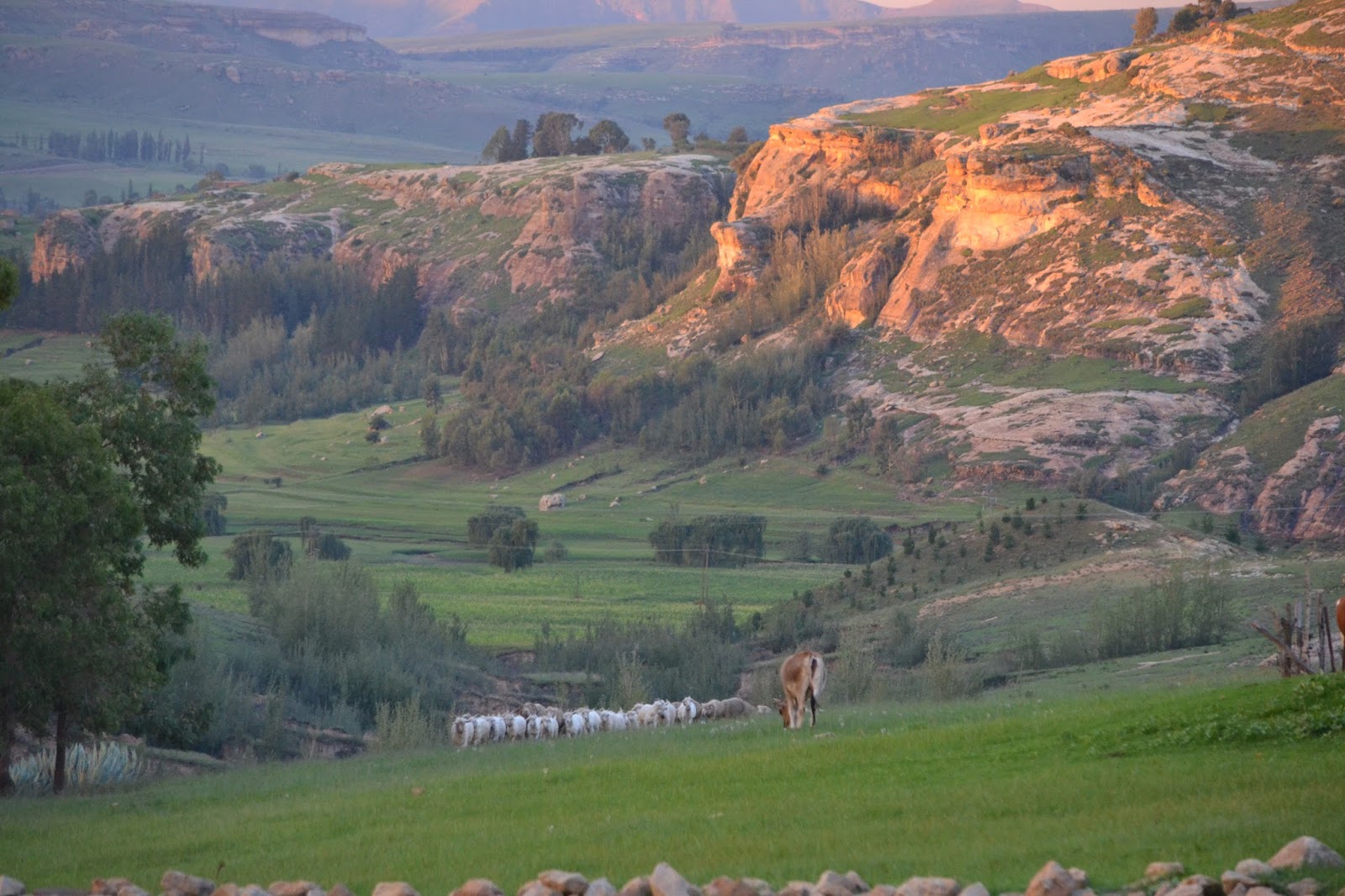
Lesotho is green again. Its beauty causes me to pause when I walk, simply to gawk and try to memorize the incredible views. We have enjoyed the occasional rain since my birthday.

When the ground first transitioned from sand into soil again, I hesitated. My family and neighbors, however, began planting greens. Eventually I moved past the dire drought predictions that were not due to expire for many more months and I too planted my gardens.

Soon to be eaten: 4/10
Spaghetti Squash.
Thanks Julie P!
I had a few tough plants that survived the drought. Three squashes had been trying their hardest to grow, watered only with waste water from my house for four months, they were barely there, but within a week of the rain, they had tripled in size. Today they are surrounded and part of the Jurassic Park of squash leaves taking over the weeds in the back yard. Unlike last year, it looks like this year I will get to harvest and even consume my bounty. After feeding goats, the pig, a donkey, and a herd of cattle last year, this is an exciting possibility.

At the same time as I celebrate my own small garden at home and the lack of dust flying constantly, the present reality is still dry. Lesotho is still in a dangerous drought. The so-called rainy season will be ending soon.

My family's greens are
growing well.
The staple foods have not grown enough. In a few months it will be time to harvest maize, sorghum, and beans. Last year's food supply will be exhausted and this year's input will be insufficient.

The groundwater supply has not been replenished this season. When rain does not fall for a week, many taps return to their dry state from before the rain finally arrived.

So, for the moment, Lesotho is green and gorgeous. I celebrate the rain, even when it is hard enough to make my roof continue leaking.

In case you missed my original post on the drought in Lesotho, Dust in the Wind is available here. Also, in February, The Guardian in the UK published an article calling this the Green Drought.

Year by Year Comparison:

January 2015: The maize is tall and people are weeding to ensure it grows well.
March 2016: The same field with significantly fewer plants. In January, this field was only ankle high and had almost no
weeds due to the lack of rain.