Featured Post

U motenya!

I leave my house for work and get called over by two village women awaiting their chance to do business with the chief. The first smiles...

Showing posts with label AMC Three Mile Island. Show all posts

Sunday, January 31, 2016

A Life Unplumbed

Life in my rural village in Lesotho is entirely unplumbed. I know of only one home in the entire 500+ family community that has indoor plumbing. Their toilet, sinks, and bathtub are fed by their own well.

For the rest of us, drawing and conserving water is a regular part of our daily life. When nature provides it for us, we collect as much as we can in whatever we can; 200L metal drums, fancy plastic rain barrels significantly larger than what people in America have, basins, buckets, etc. Given the drought this so-called “rainy” season, that has not been happening much. We recently had two weeks with great rain. Within twenty-four hours of it stopping, I spoke with a friend who was gather muddy water from puddles to save for her gardens in case the rains do not return.
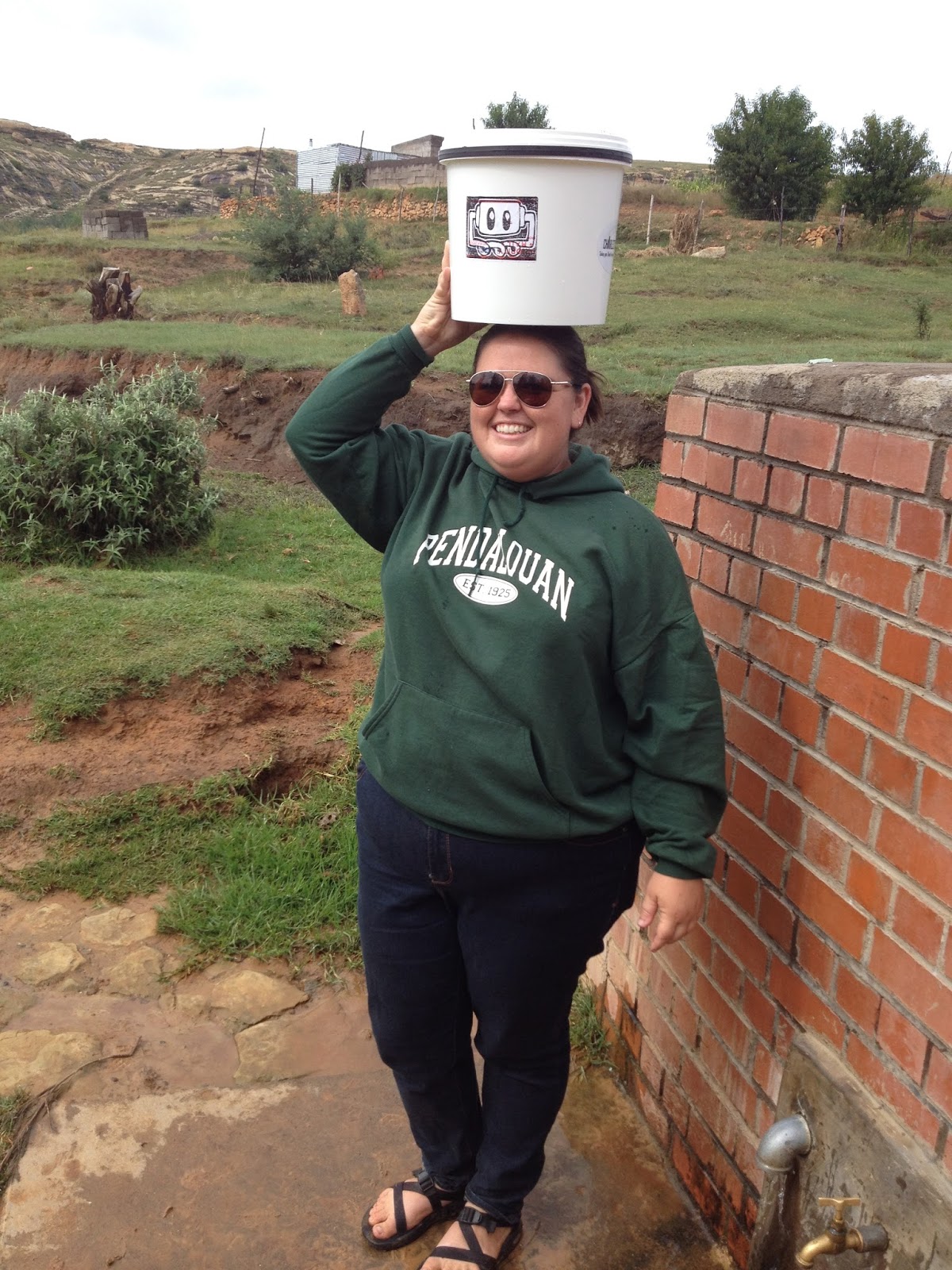
Me at the tap with 10L of water on my head,
if I walk slowly enough, my sweatshirt
might even stay dry!
So, what is it like to live life entirely unplumbed? I will share the nuances of living without plumbing; however, today I will ignore the lack of a toilet as I wrote about that in Outs. I encourage you to click through and read that post as well.

I was lucky in that I had a few dry runs (pun intended) before I joined Peace Corps. When I sailed, some vessels only plumbed the heads (toilets) and galley (kitchen) sink. When we wanted water to drink, we used the igloo that was regularly refilled in the galley. When we wanted water to clean the ship or ourselves, we filled a bucket with seawater. When I worked at AMC’s Three Mile Island, only the kitchen was plumbed, so we used Lake Winnepesaukee water for bathing. In both cases, however, I regularly engaged with the outside world-taking traditional showers and using machines for laundry.

In the last twenty months, however, I have averaged less than one traditional shower a month and have used machines to do my laundry only a handful of times. Every drop of water that I engage with for drinking, cooking, cleaning, and even watering my garden has been carried in a bucket before being put into use.


My 3 20L buckets living in the corner
My water lives in three 20L buckets gifted to me by villagers upon my arrival. Each originally held some sort of construction item, but I choose to ignore whatever carcinogens may live in them as I am sure the plastic itself is equally bad for me. I draw water at a spring-fed water tap a ten minute walk from my hut. When males draw water, they used a wheelbarrow and get 40-75 liters at a time. Women, however, typically carry 20L at a time on their heads. Younger girls will carry only 10L on their heads as they build up their neck strength. In this way, I am like a young girl, working to build up the strength and balance to carry my 10L bucket without using my hand or wearing some of the water by the time I arrive at home.

When it comes to cooking and dishes, I only notice the lack of plumbing when I want to wash bread dough off my hands. It is hard to pour water and scrub at the same time, particularly when both hands are covered in sticky. Inevitably, I also end up needing to wash the measuring cup or “water jack” I use to pour water.

There are entertaining memes that float around the internet and have even been turned into tee-shirts celebrating the ability of the PCV to bathe in limited water. While entertaining, they are reality for not just Peace Corps Volunteers, but people around the world living without plumbing. The Basotho put a high priority on cleanliness. A fellow PCV laughed a year ago when her area was dealing with a water shortage as the principal addressed her entire school, reminding them that a lack of water was not an acceptable reason for not bathing.

Most Basotho bathe at least once a day, using a basin and a small amount of water. I too, bathe regularly using about two cups of water each time. I do not, however, wash my hair very often. Well before moving to Africa, I had transitioned to using what is referred to as the “no-poo” method; using a baking soda and water mixture followed by a cider vinegar and water mixture. When I do wash my hair, currently every two to three weeks, I typically indulge by using around three liters of water. I justify this indulgence because it happens so infrequently.

Ready for a bath: towel, basin, 2 cups of water, washcloth,
pumice, nail brush (dust is brutal), and Dr. Bronner's. :-) 
Some PCVs find themselves craving showers, even going so far as to visit friendly hotels to pay for just a shower. I find that except for the dirtiest of days, I feel surprisingly clean after my bucket bathing. This lasts until a workshop puts me in a hotel with a shower and I see the amount of dirt that comes off my body when I use forty times the amount of water and time to clean myself. Then, I am temporarily embarrassed. It never lasts though, as I happily return to my bucket baths in my hut.

Laundry is a huge undertaking without plumbing. When our natural water delivery system, aka rain, is present, my family and I use the water that collects from their metal roof. We collect it in three 200L metal drums. As the water sits in the drums, it becomes a bit reddish tinted, but is still preferable to hauling the laundry downhill to the natural spring. I head out to the back yard with three or more basins, a bucket, and at least two hours. The first basin is the soapy wash, both the second and third rinses. The bucket I use to fill the basins then to collect finished items so that I am not jumping up to hang things on the clothesline one at a time. I have developed a specific order to washing my clothes based upon personal analysis of how dirty something may be combined with how close to my skin it sits. Before I am halfway through, the color of the water in the wash basin matches the dirt that the basin sits upon and the first rinse water is well on its way to being equally dirty and soapy. By the time I finish, all three basins have a layer of dirt on the bottom and soap suds in them, hence my desire to rinse the soap out of the items that sit closest to the skin first.


Flat Stanley and I do laundry at the natural spring. 
When we do not have rain, we go to a natural spring a ten minute walk downhill from the house, carrying our laundry, soap, bucket, and basins. I use water less sparingly when I wash at the spring, often doing an extra rinse in the natural basin formed by the spring. I also change the washing water out more often as the spring runs constantly so it does not feel wasteful. At the spring, my primary goal is obviously clean clothing. My secondary goal and perhaps more pressing focus is to make my wet load as light as possible before hiking back up to the house. As a result, the order of washing changes dramatically from when I wash at home. I wash the heaviest items first, laying them out on the rocks that surround the spring. There is a science to choosing the right rocks as the reddish toned ones will leech onto your cloths, staining them. Additionally, the rocks must be easily rinsed of dirt and just steep enough to let the water drip out quickly without the clothes falling off the rock. Lastly, some rocks are popular walking paths for the goats, sheep, and cows that come to the spring for drinks and there is nothing worse than a goat walking all over your freshly laundered items.

Wednesday, December 31, 2014

Morning Reflection-NYE

I'm sitting outside my hut, on an old sheet to keep the light colored pants Debbie gave me clean rather than to appease the Basotho concerns of cold cement causing hemorrhoids. My feet luxuriate in the soft sand that comprises our front yard. Most mornings are too hot and too sunny for this, however, today is gray with just enough humidity to make the occasional light breeze welcome instead of cold.

I sip my coffee and consider making a second cup. This time last year, the consideration would have been a second pot, as the second cup was a given, but now real coffee is a luxury usually shipped by a generous and loving person back home.

In the distance, I can hear villagers shrieks of joy-it is New Year's Eve after all. Next door, I hear Ntate Thamahane conducting village business. Occasionally my quiet morning is interrupted by a villager walking to the chief's place, which requires we go through the usual Basotho greetings.

Relishing my bare feet in the sand, I remember an older man at Three Mile Island last summer telling me he believes people should have a physical connection to the Earth as often as possible for health reasons. While this sounds like the musings of a back to nature person, he was otherwise a very conservation and professional individual. I remember we discussed the way sea turtles us the Earth's magnetic force to direct thousand miles journeys (because I always want to discuss sea turtles) and that we too should allow our bodies to experience that connection to the Earth. Now, a year and a half later, I am sitting on the other wise of the world, fully appreciating that connection.

As New Year's Eve often induces reflection, I cannot help but wonder at all the paths that led me to this moment. It seems like every stepping stone has focused on connection and simplicity, often removing those things that separate us from such a connection. How many of my jobs have put me in a place to experience life without the usual trappings of electricity and the modern world: television, unlimited high-speed internet, regular hot showers, traditional flush toilets, etc.

In a world filled with reaching towards the next big thing-be it the newest iPhone, marriage, kids, a mortgage, or a new car-I find myself stepping away; craving and pursuing jobs that are lifestyles in simplicity. The immense peace I feel sitting on the cement, leaning on my dung and mud hut on this gray day is the same as I captured when at sea, grading handwritten essays on the deck of a schooner. It is the same as I found sitting on the deck of my cabin during a summer thunderstorm at Three Mile Island. It is the same as I enjoyed each early morning walk down to Nikana Lodge at Camp Pendalouan, looking out at Big Blue Lake's serene facade in the silence just before camp truly awoke. It is early mornings and late nights in Charleston, sitting on the Spirit of South Carolina while looking out over the harbor and marveling that life brought these moments over and over again.

Fifteen years ago, none of these were on my list of dreams. I graduated high school and started college in pursuit of suits and salaries; the American dream. Somehow, despite my desire to be unique, I followed the cliché and found myself during those college years. In doing so, I realized the reality of a career indoors, of reaching for promotions, of following the usual path set out by the game of Life (graduate, job, wedding, house, babies...) unpalatable. Thanks to a simple daysail on Niagara with my mom and a summer of fitness and hiking in Maine, I realized there were other options and the only limiting factor was me.


And so, I find myself in the perfect place this New Year's Eve morning: sitting outside, barefoot, with that second cup of coffee. As the hot summer sun begins to burn its way through the clouds and will soon chase me inside, I cannot help but look ahead to 2015 with excitement. It may be the only year of my life spent exclusively outside of my home country. I doubt it will be filled with only the serenity I feel in this moment, but I can always return to my happy place: barefoot, outside, with coffee. And, I will always appreciate the simplicity of life in a place where my slowest walk is regularly commented on as too fast. 


Special thanks to Mom, Julie P, and Eric G for supporting this moment through gifts of coffee. 

Wednesday, November 19, 2014

Outs

Apparently today, November 19, has been declared World Toilet Day by the United Nations. You can learn more about why the UN is bringing awareness to the value of toilets here: http://www.unwater.org/worldtoiletday. It is actually a real issue worth highlighting. I wrote the blog post below a few days ago and given that it's World Toilet Day, it seems like the right time to drop it. Enjoy!

If you are one of those people who dislikes acknowledging that we civilized humans have well-developed and very important GI systems that include the removal of waste, this is not the blogpost for you. Leave now! Or at least consider yourself warned. Today I am discussing something that is an integral part of my everyday: human waste.

My awareness of human waste and its disposal has been a regular part of my professional adult life. Many of my peers arrived in Africa a bit skittish at the thought of dirty latrines and the very likely possibility of GI problems. I, on the other hand, have spent a decade with an awareness of when, where, and in what way human waste can be removed from the ship. I have regularly explained to students what can go into the marine head and what to do if things do not disappear the way they “should” after pumping the handle correctly. Similarly, when on land, I often find myself drawn to places where pit latrines are the only private option. I even spent my last summer in the US including the discussion of “humanure” in my composting classes at AMC's Three Mile Island.

It stands to reason then that the options for removing waste from the body in Africa would not phase me much. In fact, they tend to amuse me more than disgust me.

Young Children:
Once out of diapers, most young children are taught to always go outside. It is not unusual for a three year old child to drop into a squat only feet from other people to discharge both ones and twos. During training, the young children were always so excited to wave to our bus, that sometimes they would stop in the middle of discharging waste to wave to us!

Latrines:
Personally, I love my latrine. When I was working on Three Mile Island, I created signage about water usage and waste for out latrines. It astonished me to think about how much treated water is used throughout America to “wash away” our waste. I am not suggesting the entire world revert back to pit toilets, especially in urban settings, as this would create other issues such as aroma and the potential for disease to spread more easily.

At the same time, I take joy in knowing that at the moment, my waste does not need water to wash it away. Despite my latrine being brand new when I arrived and despite my following the keep it covered rule, my latrine had a serious fly problem for a few months. Finally, tired of blasting DOOM, a local pesticide, into the latrine to annihilate the flies, I called upon an expert-one of the guys I worked with back on Three Mile Island, where our latrines serviced over 100 people a week for the duration of the summer-Jake.

As Maintenance Manager for TMI, Jake had spent a lot of time looking into options for reducing fly populations and odor in the traditional latrines on the island. He suggested adding a bucket of water to the latrine from time to time-not an ideal option here, but doable during big rains. He also suggested I look at a company called AMKA Organico, a company based in South Africa he had looked at but not yet tried out.

A bit of research online showed they have a product called SuperSeptic, which uses biotics to reduce odors and fly breeding in latrines. The biotics also help waste break down faster than occurs naturally. A few weeks later, I stumbled upon it in one of the three grocery stores in my camp town. I read the package and decided to test it out.

Super Septic suggests using is weekly for the first month as an appropriate level of the helpful bacteria is established. After that, one use per month is said to be sufficient. It also suggests adding a bucket of water with each treatment to help with waste breakdown. Lastly, it stresses that detergents and chemicals are a big no-no as they will kill the bacteria. At 15R or $1.50 US, it was well worth a test even if it did not work.

The first week, I noticed an immediate reduction in flies and by day two, the smells come out of my latrine were almost floral. Unfortunately, this was before the rains really started and my enthusiasm to put as much liquid into the latrine as I could meant that toothpaste went in to. By day 5, the flies were back and living happily. I bumped up the next treatment by a day and started separating gray water in the house to ensure I did not accidentally kill off my bacteria.

At the end of the second week, things were still looking good. The rains had started, so it became easier to add a bucket of water with the treatment. Now, I am about to add the last of my weekly treatments before transitioning to monthlies. While flies still enjoy hanging out in the shade created by my latrine, they are not down in the pit, which means that Super Septic has eliminated a breeding space. Hooray!

Pee Buckets:
My beautiful pee bucket!
Pee Buckets are the gem of Peace Corps life throughout the world. Our first day in country we were given a bucket by Peace Corps along with instructions to use it instead of the latrine at night. The instructions, given by current, more experienced PCVs, came with some tips and tricks. They strongly suggested only using the bucket for pee. If one needed to do more than that, it was “recommended” that one use a plastic bag at the mouth of the bucket to capture the waste so it could be tied up and would not foul the precious pee bucket.

While some people in training openly bragged about how often they poo'd in their pee buckets, others discretely acknowledged “they aren't just for pee!” in an adorable and playful voice. Still others worked diligently to master the art of using a bag in the bucket for solids.

I am lucky enough that I rarely need to use my pee bucket for more than pee, however, I find the bag in the bucket method to be pretty ridiculous. The theory is that it is more hygenic, cleaner...however, the tied up shopping bag is then left in the bucket until it is dumped into the latrine with the liquid waste in the morning. We all know shopping bags are not hermetically sealed, so the germs are still present in the bucket despite the use of the bag. Additionally, tying up natural waste (be it food pre- or post-digestion) in plastic makes it harder to break down once added to the latrine. Lastly, the pee bucket is like a portable toilet or chamber pot. Like a toilet, it needs to be cleaned with detergents from time to time. Why go through the challenge of training yourself to poo in plastic bags when all you need to do is wash your bucket more often?

In short, human waste is natural. It's not that hard to clean up safely and effectively. Why make it more awkward and clutter up a latrine with a bunch of plastic bags that negatively impact natural decomposition?

When there's no Water:
Most of the camp towns (district capitals) in Lesotho have flush toilets and sinks for washing. Despite my love for my latrine and pee bucket, I still appreciate flushing a toilet from time to time. The excitement, however, comes from being in town all day on a day there is no water. The downside to having the flushing toilets is that there are few places to go privately when there is no water.

Two weeks ago, I was at the taxi rank and desperately needed to use the public toilets before hopping on my taxi for a bumpy ride home. With no water, however, they were closed. I spoke to the attendant for a few minutes and asked if I could just go to the taxi rank fence and squat like the children do. This was met with a firm no, as that is not private enough for a woman.

Once the attendant learned I needed only to pee, she directed me to a small brick closet off the public bathrooms. She told me there was a woman there with a bucket I could use. I went and knocked. The woman welcomed me in. The “office” or closet was not much bigger than a large portapotty. The woman continued sitting at her small desk and simply pointed to the bucket. As I squatted, her phone rang. I could not help but laugh to myself as I peed in this small space while the woman sat there talking on her phone. In Lesotho, woman sharing space like this is normal, even when they do not know each other. After I finished, I took the bucket out to dump it in a nearby grate, and returned it with many thanks. Sometimes basic needs trump the desire for privacy.

Traditions:
Legend has it, you are not a Peace Corps volunteer until you poop your pants while on public transportation. This probably comes from the reality that many PCVs encounter serious diarrhea at some point during their service. I have one friend who acknowledges this has happened to him not once, not twice, but three times. I am pleased to say, it has not happened to me as of yet and I am praying it never does!