Featured Post

U motenya!

I leave my house for work and get called over by two village women awaiting their chance to do business with the chief. The first smiles...

Showing posts with label PCV. PC Third Goal. Show all posts

Monday, October 31, 2016

Hardship Hits Hardest at Home

My suddenly very adult brother,
Abuti Thabo, at the mine. 
I stare at the screen of my phone and blink back tears of frustration and anger as I reread my brother's text message: "I miss you too my sister. I don't think I will come for writing [my exams] because they are disallowing me to come write."

One week before receiving this frustrating text, I had been sitting in the hall at my brother's school; beaming as he received the Leadership Award. Now, I am sitting in that same hall doing Camp BRO. I am forced to be on my game-inspiring young men to be positive leaders for social change-when all I want to do is mourn the future I imagined for my brother.

My amazing and inspiring brother will not be completing secondary school at the end of November as planned. He will not be writing the intense Form E exams to earn his certificate—the Lesotho equivalent of a diploma.

Instead, he is now an employee at a platinum mine in South Africa; taking on the job his father held before his untimely death a decade ago due to “mine-related illness.” Because the mine acknowledged responsibility for his illness, they have been holding a position for my brother for the past decade.

Monday, September 12, 2016

Two Years and Sixteen Volunteers


Fresh off the plane: June 5, 2014
Last week I highlighted the accomplishments of my Peace Corps training group in light of our work as defined by and reported to Peace Corps. Numbers of people reached in specific topics, however, only shares a small portion of our story.

One of my favorite things about the Healthy Youth program in Lesotho, is that each volunteer’s job responsibilities and activities are unique to their site. As a result, we worked in a number of areas, some overlapping and some unique to only one or two of us. Here is a sampling of the work that filled our days:

Health


  • Worked in a clinic to increase ARV adherence and infant wellness checks 
  • Weighed infants and worked with Village Health Workers in an outreach clinic
  • Started a growth monitoring and intervention program at an orphanage
  • Worked with three HIV+ Teen Clubs


Youth Development


  • Directed 6 overnight camps serving more than 425 girls and boys in six of Lesotho’s ten districts
  • Completed more than 20 Grassroot Soccer Interventions to educate on HIV prevention
  • Tutored herdboys in computer skills
  • Started and led Youth Clubs in Athletics, Gender Empowerment, Drawing, Games, English, and English Reading

PCV Stephanie and colleagues show off the produce at
the orphanage she worked with.
Photo provided by Stephanie Sales.

Income Generation to Support Families and OVCs


  • Two community-based sewing businesses
  • A farm including water accessibility for an orphanage
  • Started three chicken projects
  • An achaar project
  • Fenced a farm and orchard to protect product from cattle
  • Advised five agricultural co-operatives
  • Helped a women’s and girl’s weaving group with marketing and market development

Community Engagement


  • Planned  and led four World AIDS Day events including talent shows, voluntary HIV testing, 
  • Built a multi-purpose athletic court for one of Lesotho’s largest towns
  • Planned and led a Spread the Love, Not the Disease Valentine’s Day event with over 100 youth participants enjoying face painting, nutrition and fitness info, yoga, HIV testing, and Planned Parenthood
  • Hosted a large HIV awareness, testing, and education day for youth
  • Built a Community Building with a children’s library
  • Worked with Caregiver and OVC Support groups in four communities; building the capacity of caregivers 
  • Led a father’s support group through the Red Cross
  • Built small greenhouses with families and provided nutrition and gardening lessons to build food security

Education


PCV Eloise's students at the Khotsong Skills Training
Center, a tertiary school.
Photo provided by Eloise Williams
  • Started computer labs at 2 tertiary schools
  • Worked with a school to help it get internet access for students and teachers
  • Taught primary school classes in Life Skills, English & Creative Writing, and Dance
  • Taught Life Skills in secondary schools
  • Taught at 3 tertiary institutions


Lesotho 82 Peace Corps Volunteers and their counterparts at a workshop.


Tuesday, August 23, 2016

Chicken Coop Construction: Weeks 5 and 6


Construction Completed!!
Week Five: We have completion! Well, construction completion anyway. Although the house is not yet ready for chickens to arrive, the roof is completed and well secured for its windy locale. Although I missed watching the team finish the house, I learned of their accomplishment before boarding my taxi to come home. Multiple people in town stopped me in my tracks; thrilled me to tell me that the chicken house was done and beautiful.

As my taxi crested the hill before our building site, I caught me breath eager to see the completed project. It looks wonderful!

Week Six: When week five started, a friend helped me schedule someone to install burglar bars in the house on Sunday of week six. In my head, with burglar proofing happening Sunday, the cages would also get installed this week.

Clearly I should not develop expectations, even when things are scheduled and we have asked a million clarifying questions in two languages.

When the man building and installing our burglar proofing arrived, we were all stunned. He was shocked to learn we do not have electricity in our village. Bo-‘M’e and I were equally blown away that he never mentioned needing electricity to complete his work.

As PCVs, we are supposed to work with host country nationals in all things. This is to build their capacity to do the work after we return home. In this case, I am grateful to have worked alongside women in my organization as otherwise I would have feared my language skills caused the confusion and delay.

Still waiting for burglar bars on these windows, but wow,
that roof is pretty!
One of the leaders in my organization and I had spoken to this man twice in person. The first time was when we were getting a quote for building supplies and pricing. He looked at the printed list of supplies and said we had everything we needed listed and priced his work. The second time we spoke was on the day that we bought the building supplies. Again, we checked to ensure we had everything as we did not want to have to hire a vehicle for later deliveries of building supplies. Again, he confirmed we had everything and he gave us his contact information.

I have an incredibly hard time understanding this man’s Sesotho, so it is possible that I would have missed any mention of electricity despite knowing the word. I was, however, working alongside ‘M’e ‘Majustice and a woman from the building supply store. ‘M’e ‘Majustice knows that we do not have electricity in our villages. She would have quickly jumped in had he suggested anything connected to moltakasa or use of a generator. I do understand her Sesotho. The woman from the store translated many of his words into English for me and I am certain this important fact would not have been ignored as much of our district does not have electricity.

As a result of this miscommunication, we spent two hours trying to find a generator for the following week. His job at the building supply store makes him only available to do the work on Sundays. He made it clear that we needed a large generator. When he looked at the first one we found, it was too small. We went to another family’s home to see their larger generator. Although larger than the first, it too was too small. Then he clarified the power of the generator we needed-double the first one we had looked at. As we walked back to my supervisor’s, I expressed concern that we may be unable to find one that large as our village does not have people rich enough to have such large generators and we do not have the money to rent one from somewhere else.

Before he departed for the day, I asked him to take a look at our supplies again, just to be sure that if and when he returns we actually have everything needed to do the job in one day. It turns out that we are missing square “tubing” to serve as the outside of the burglar door frame. We need to buy two sections. Apparently, checking the list when we were at the building supply store on two separate occasions did not highlight this important missing piece. Buying these now will require hiring a truck as they are too long to strap to the top of our taxis.
One of the women in my organization poses with the
completed chicken house before our meeting.

So now we have to figure out how to find a huge generator, buy oil and petrol for it, buy the two sections of square tubing, and hire a vehicle to deliver the tubing or we have to find a new person to do the work; one who can arrive with and by his own power. This lack of clarity looks to more than double the anticipated cost of burglar proofing the chicken house in addition to slowing us down.

Despite my frustrations with the man who was to do the work, I am surprisingly unfazed by the situation. Obviously, my expectations are shifting and I am becoming more accepting of the twists and turns in the project.

Bo-‘M’e and I visit numerous houses in multiple villages trying to secure a generator large enough for the project. We are unsuccessful, however, my visit to town to get new quotes from people with larger shops gets us a few reasonable quotes that come complete with transport, installation (including bringing their own generator), and the supplies. As predicted things will be twice what we estimated, but a careful look over the budget and remaining funds reassures me we can still afford this vital step in our project. 


MCCC’s Egg Laying Chicken Project has been in development since March 2015. After many delays, MCCC and I were able to write a successful grant proposal for a VAST grant through Peace Corps. VAST grants are funded by PEPFAR to help with HIV-related work and OVC (Orphan and Vulnerable Children) care. It is due to MCCC’s work with OCVs that qualified us for the VAST grant. Otherwise, we would have applied for a PCPP [Peace Corps Partnership Program] grant and would have been asking for assistance in funding this grant proposal. I encourage you to consider supporting other PCPP projects.

Posts about this project include:

Wednesday, August 10, 2016

Chicken Coop Construction: Weeks 2-4

Week Two:
The view from the door includes a...floor!
Although I was away from site for the second week of construction, the building team was eager to move forward. Unfortunately, as they prepared to begin putting on the roof, they discovered we did not have enough cement bricks remaining to elevate the high side of the roof.

They send me a message letting me know and attempted to get the women in my organization to come up with a solution. Bricks and other building supplies are, apparently, an exception to the Basotho tradition of borrowing things that are needed. As a result, no bricks could even be ordered until the morning I returned, five days after it was determined we needed fifty more bricks.

The guys did break with building tradition though, pouring the concrete floor even though the roof was not yet in place. They even created a step up to the door, which was a pleasant surprise for me.

Week Three:
Week Three started with me buying more bricks. When asked, the brick-makers assured me that they would deliver within the week, but probably on Monday. This would mean that the work could be completed on either Monday or Tuesday. My host brother and I stressed the importance of receiving the bricks as soon as possible so we could finish work before he and other students had to return to school.

Constructing the beams for the roof
Mother Nature decided to surprise Lesotho with precipitation on both Monday and Tuesday, so the bricks never materialized. Throughout the week, we kept an eye out for them. Finally, on Saturday afternoon, they arrived.

Week Four:

Although I was at (another) Peace Corps workshop in anticipation of the upcoming Pre-Service Training, the team got to work after the bricks arrived. When I returned home on Friday, I hopped out at the building site to check in and see their progress.

Surprisingly, the fifty bricks I bought two weeks earlier were not actually enough to finish things up. I learned that we would need 32 more bricks! Anticipating another long walk to the brickyard and a lengthy delay waiting for delivery, I was a disappointed.

Our need for only these 35 bricks had the potential to slow
the project down by another week or two!
I stopped by my supervisor’s house and spoke with the MCCC members there. We started brainstorming people in the village who might have some extra bricks we could buy instead. By the time I left, my supervisor had agreed to ask her son if we could buy his. Saturday morning, I headed over to learn if I needed to hoof it to the brickyard before they closed at one.


Thankfully, my supervisor’s son was thrilled to sell us 35 bricks he had leftover from a previous project. He kept telling me that I was actually helping him more than he was helping us (lies!). As a result, Week Five will dawn with a Sunday workday and the guys anticipate being done by Tuesday afternoon. 


MCCC’s Egg Laying Chicken Project has been in development since March 2015. After many delays, MCCC and I were able to write a successful grant proposal for a VAST grant through Peace Corps. VAST grants are funded by PEPFAR to help with HIV-related work and OVC (Orphan and Vulnerable Children) care. It is due to MCCC’s work with OCVs that qualified us for the VAST grant. Otherwise, we would have applied for a PCPP [Peace Corps Partnership Program] grant and would have been asking for assistance in funding this grant proposal. I encourage you to consider supporting other PCPP projects.

Posts about this project include:

Friday, May 06, 2016

Adventures in Mabita: Clarens Weekend

While Botha Bothe is limited in its tourist attractions, it is only a short drive (especially in a private car) to many other places. One of these is the South African town of Clarens.

I recently went to Clarens for the first time with fellow PCV Nick. Clarens was, for us, an three-night adventure in walking, eating, and drinking. As a top tourist spot in Orange Free State, the small town has a number of locally owned restaurants, a brewery, small shops, and over a dozen art galleries.


Nick and me on the hills overlooking Clarens. 
Walking: Although it started as just walking around town and checking out the shops and galleries, we soon learned that the town has a conservancy that made and maintains a number of walking and hiking trails on the outskirts of town. Although there are town maps with the trails noted, we splurged on the inexpensive detailed map. We spent half of each day walking the trails.

While walking is a normal part of life in Lesotho, these trails were well designed and free from the animal dung that must be dodged on the paths I usually walk.


Eating: On my other vacations in South Africa, dining has been a small part of the experience with destinations, adventures, and wild animals being a bigger priority. In Clarens, however, it was all about food...so much food! We ate out every meal but one...and that meal comprised bread, cheese, sausage, and fig jelly from a nearby bakery.

All this and dessert??
Highlights of the eating included a  giant burger, a cheese plate, a sausage plate at a German place, waffles covered in mince, eggs, and cheese, and salmon blue cheese pasta. The clear winner, though, was everything from the Courtyard Cafe. We first went for their renowned Sunday lunch buffet, which was perhaps the most I have eaten in one sitting in a decade. It was absolutely amazing.

Our one at home dinner was purchased at their bakery. Monday morning the town becomes a sleepy shell of its weekend activity and a number of places were closed, so we returned and I drooled over salmon eggs benedict. Before we left town, we grabbed two muffins from their bakery, making four consecutive meals from the same place!
Yummy stout

Drinking: Normally, I get more excited about wine than beer. In Clarens, however, my excitement lay with delicious locally brewed stout from the Clarens Brewery. It was exactly what this dark beer loving lady needed after going through a dark beer drought since departing America. Seriously, I think I had more good dark beer in Clarens than in the previous 21 months despite having a porter in America in October and a porter in Cape Town in August.


My other favorite beverage, of course, will always be coffee. Nearly every restaurant in Clarens had great coffee options-particularly espresso based treats like cappuccinos. In case that was not enough to keep me caffeinated and moving, daily deliciousness from Highland Coffee filled each morning topped off with free Wi-Fi (something not often experienced reliably in Lesotho). Happy Beth!

Sleeping: We stayed at the Clarens Inn & Backpackers. This place is a large rambling estate with significantly more space than meets the eye. It has a lot of personality, each room and separate building has its own style and name. Eccentricity meets relaxation. Although it is a ten minute walk from the town square, it sits directly off the local trails.

Spoiling Oneself: Clarens also allowed me to get my favorite rare treat: a pedicure. Just before we left, I visited the Wellness Day Spa, where I had the best pedicure of my entire life. My toes are now a beautiful teal and looking much happier than they have in ages. The relaxing on a massage table with a lavender compress on my eyes was not too difficult either!


Other Adventures in Mabita:
     Ts'ehlanyane National Park
     Liphofung Caves


Saturday, April 09, 2016

My New Approach to Proposals

In the last few months, talk of my anticipated departure has monopolized conversations with community members. Although my cohort's scheduled close of service is still more than four months away, people have amusing reactions to the impending date. 

Some people react with shock, amazed like I am that two years can pass so quickly. 

Others, after not seeing me around for a week or so, greet me with relief and joy, thrilled to learn I have not yet departed.

Most tell me I am simply not allowed to return home for a few more years. 

Most surprising, however, is the huge number of people bringing up a topic previously ignored within my home community: my marital status. 

I noted in Love and Marriage that the guys in my village were well prepared for my arrival, the chief making it clear that I was not to be pursued. Similarly, when I first arrived, women would ask about a husband or children in American and then drop the subject when learning I have neither. 

Now, however, my marital status is a hot topic. Everyone wants me to marry. The women I work with insist I need to marry and stay in our community. Uncles, mothers, and grandparents of male friends offer to talk to my family in America to negotiate my bride price, as that is the responsibility of the family here in Lesotho. 

The other day, a man who regularly tells my brother that his in love with me—which has turned into quite the joke between them as Abuti Thabo heckles him whenever we cross his path—asked me if my husband had visited that morning. Although I understood his Sesotho, I was so confused I made him repeat himself, twice.

Apparently, the male driver of the Peace Corps car that had visited that morning is, or should be, my husband.

I can see the growth in my cultural understanding and acceptance. When I arrived, this focus on my husband (or lack thereof) would have frustrated me to no end. I spent my whole first year in Lesotho collecting stories of ridiculous pick up lines and women from outside my community insisting I would marry their son only minutes after telling me their sons all had wives.

When I wrote about my favorite pick up lines (See Love and Marriage, above) from the first year, I fully intended to do a follow up a year later with more gems. Now, I cannot even remember any from the last few weeks! It is not that men have stopped proposing, I simply stopped paying attention when they do. Instead of fixating on how dramatically their proposals and declarations offend my American culture, I have moved into full acceptance of their Basotho culture. I simply laugh and joke with them before moving on to less boring topics.

Similarly, as my community tries to marry me off before I finish my Peace Corps service, I am able to laugh, recognizing that they are not trying to control me or diminish my adventurous spirit. They are simply making it clear that they love me and that I truly belong. They do not want me to leave and the best way to keep me close is to have me settle down with a husband and children.


So I take the compliment with joy and continue to nicely refuse generous offers. 

Sunday, March 20, 2016

PCV Profile: Nick

Nick hanging out with his youngest host brother Thabiso.
Within my training group, there are only fifteen of us spread throughout seven of Lesotho's ten districts. Only one person in the group lives within a few hours of me: Nick. As a result, he has become my closest PCV pal-both geographically and in actuality. Consequently, I have been to multiple special events at LASTC, his workplace, including graduation and a cultural day.

Although the youngest in our training group, Nick is possibly the most ambitious. With only four of our twenty-seven months remaining, Nick already knows his path for the next 7 to 10 years. In the fall, he will begin graduate school to earn a Masters of Public Health at one of the many schools smart enough to accept him (his acceptance rate is currently 100%!). Focusing on global health will help him prepare for medical school and a career as a traveling physician-think Doctors Without Borders.

Nick's background makes him a perfect match for a health-related role in Peace Corps Lesotho, yet, his assignment is predominately youth development. Despite studying neuroscience as an undergrad and holding his CNA license, in Lesotho, Nick has lived the life of an educator. He works for a tertiary school offering two-year certificates in agriculture and business. His work at the Agric Skills Training Center consists predominantly of teaching life skills, communication, and computers. While these subjects do not appear to be a perfect match for him, Nick has adapted his other experiences well to his current role as a PCV.

Nick with colleagues at the LASTC Cultural Day.
He uses his experiences as a founding member of his university's Toastmasters Club to enhance his public speaking classes. His passion for computers and technology have provided fodder for his computer classes and for helping the school staff improve grading programs and more. Life Skills classes have provided the most opportunities for his interest in health as it is impossible to teach life skills in Lesotho without discussing sexual and reproductive health and HIV/AIDS.

Aside from his primary assignment, which takes up a large amount of time, Nick regularly participates in Peace Corps activities. He has spent our entire service as the PC security representative for his district, which includes weekly communication between PCVs and the Peace Corps office. He is on the Information, Communication, and Technology committee, which he co-chaired last year. He also helped significantly with my Camp GLOW last year.

Luckily for the school, one of Nick's greatest flaws is also a huge asset: generosity. As the school has not computers for his computer class, Nick has spent the last two years teaching dozens of students using only his tiny, "ancient" personal laptop. This will hopefully change before he finishes his work in Lesotho as Nick and his school have recently been approved for a Peace Corps Partnership Program grant to build a computer lab with ten desktops.

As Nick prepares to head off to the University of Arizona for graduate school, it will be fun to watch his ambitions become realities.
Kathy and Nick are wild animals in the roadway after
hiking at Tsehlanyane National Park.

Sunday, January 31, 2016

A Life Unplumbed

Life in my rural village in Lesotho is entirely unplumbed. I know of only one home in the entire 500+ family community that has indoor plumbing. Their toilet, sinks, and bathtub are fed by their own well.

For the rest of us, drawing and conserving water is a regular part of our daily life. When nature provides it for us, we collect as much as we can in whatever we can; 200L metal drums, fancy plastic rain barrels significantly larger than what people in America have, basins, buckets, etc. Given the drought this so-called “rainy” season, that has not been happening much. We recently had two weeks with great rain. Within twenty-four hours of it stopping, I spoke with a friend who was gather muddy water from puddles to save for her gardens in case the rains do not return.

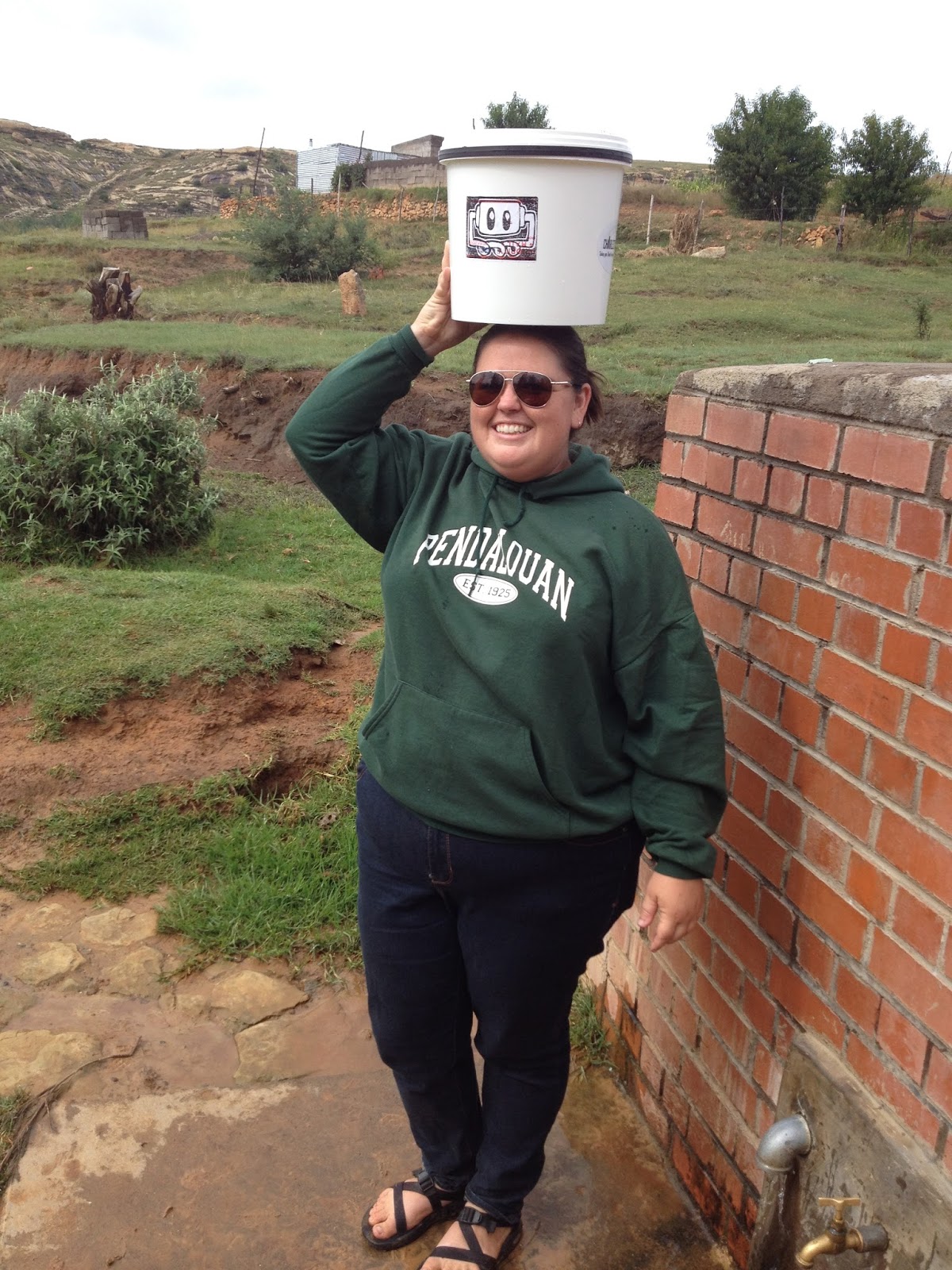
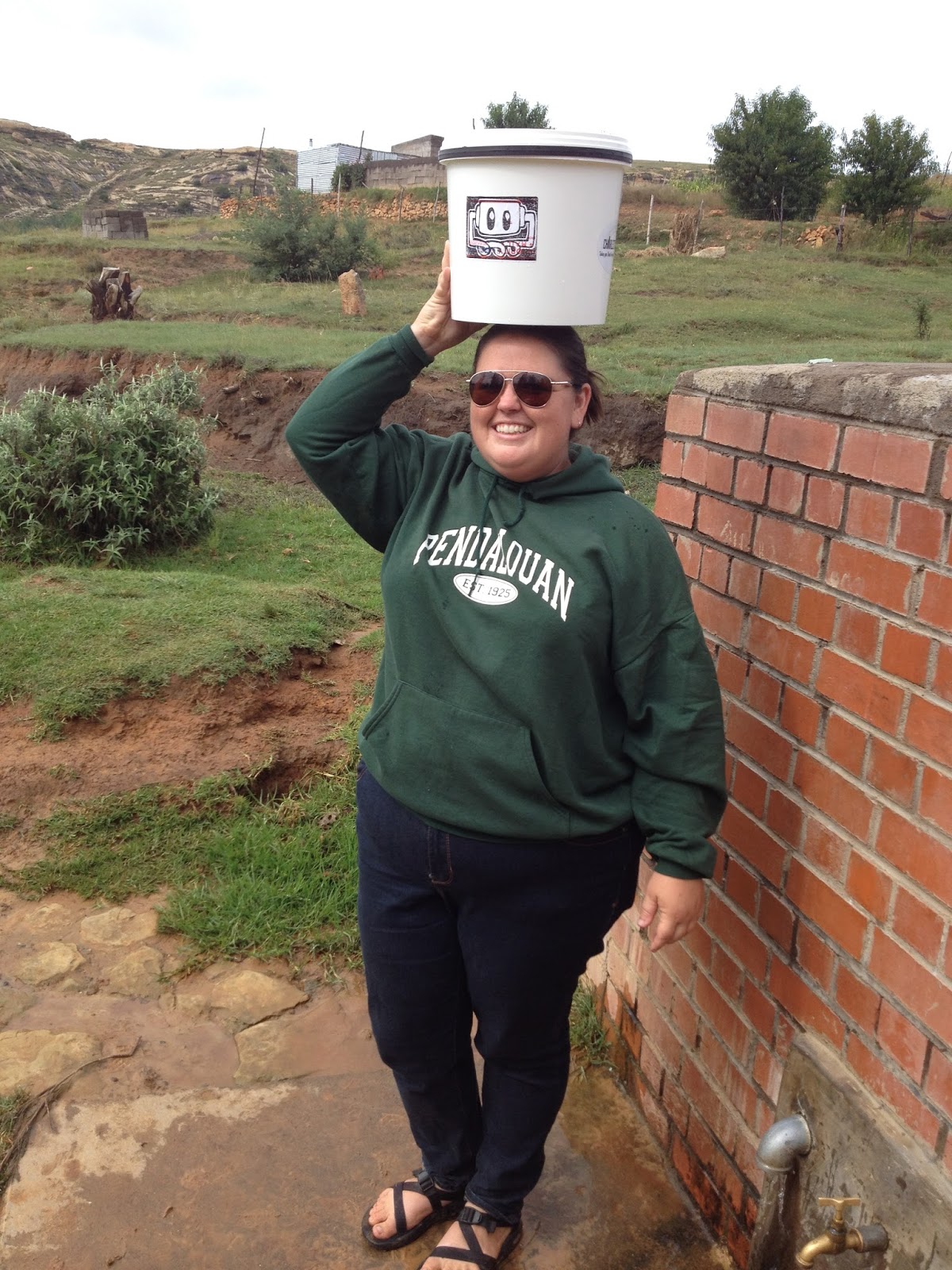
Me at the tap with 10L of water on my head,
if I walk slowly enough, my sweatshirt
might even stay dry!
So, what is it like to live life entirely unplumbed? I will share the nuances of living without plumbing; however, today I will ignore the lack of a toilet as I wrote about that in Outs. I encourage you to click through and read that post as well.

I was lucky in that I had a few dry runs (pun intended) before I joined Peace Corps. When I sailed, some vessels only plumbed the heads (toilets) and galley (kitchen) sink. When we wanted water to drink, we used the igloo that was regularly refilled in the galley. When we wanted water to clean the ship or ourselves, we filled a bucket with seawater. When I worked at AMC’s Three Mile Island, only the kitchen was plumbed, so we used Lake Winnepesaukee water for bathing. In both cases, however, I regularly engaged with the outside world-taking traditional showers and using machines for laundry.

In the last twenty months, however, I have averaged less than one traditional shower a month and have used machines to do my laundry only a handful of times. Every drop of water that I engage with for drinking, cooking, cleaning, and even watering my garden has been carried in a bucket before being put into use.


My 3 20L buckets living in the corner
My water lives in three 20L buckets gifted to me by villagers upon my arrival. Each originally held some sort of construction item, but I choose to ignore whatever carcinogens may live in them as I am sure the plastic itself is equally bad for me. I draw water at a spring-fed water tap a ten minute walk from my hut. When males draw water, they used a wheelbarrow and get 40-75 liters at a time. Women, however, typically carry 20L at a time on their heads. Younger girls will carry only 10L on their heads as they build up their neck strength. In this way, I am like a young girl, working to build up the strength and balance to carry my 10L bucket without using my hand or wearing some of the water by the time I arrive at home.

When it comes to cooking and dishes, I only notice the lack of plumbing when I want to wash bread dough off my hands. It is hard to pour water and scrub at the same time, particularly when both hands are covered in sticky. Inevitably, I also end up needing to wash the measuring cup or “water jack” I use to pour water.

There are entertaining memes that float around the internet and have even been turned into tee-shirts celebrating the ability of the PCV to bathe in limited water. While entertaining, they are reality for not just Peace Corps Volunteers, but people around the world living without plumbing. The Basotho put a high priority on cleanliness. A fellow PCV laughed a year ago when her area was dealing with a water shortage as the principal addressed her entire school, reminding them that a lack of water was not an acceptable reason for not bathing.

Most Basotho bathe at least once a day, using a basin and a small amount of water. I too, bathe regularly using about two cups of water each time. I do not, however, wash my hair very often. Well before moving to Africa, I had transitioned to using what is referred to as the “no-poo” method; using a baking soda and water mixture followed by a cider vinegar and water mixture. When I do wash my hair, currently every two to three weeks, I typically indulge by using around three liters of water. I justify this indulgence because it happens so infrequently.

Ready for a bath: towel, basin, 2 cups of water, washcloth,
pumice, nail brush (dust is brutal), and Dr. Bronner's. :-) 
Some PCVs find themselves craving showers, even going so far as to visit friendly hotels to pay for just a shower. I find that except for the dirtiest of days, I feel surprisingly clean after my bucket bathing. This lasts until a workshop puts me in a hotel with a shower and I see the amount of dirt that comes off my body when I use forty times the amount of water and time to clean myself. Then, I am temporarily embarrassed. It never lasts though, as I happily return to my bucket baths in my hut.

Laundry is a huge undertaking without plumbing. When our natural water delivery system, aka rain, is present, my family and I use the water that collects from their metal roof. We collect it in three 200L metal drums. As the water sits in the drums, it becomes a bit reddish tinted, but is still preferable to hauling the laundry downhill to the natural spring. I head out to the back yard with three or more basins, a bucket, and at least two hours. The first basin is the soapy wash, both the second and third rinses. The bucket I use to fill the basins then to collect finished items so that I am not jumping up to hang things on the clothesline one at a time. I have developed a specific order to washing my clothes based upon personal analysis of how dirty something may be combined with how close to my skin it sits. Before I am halfway through, the color of the water in the wash basin matches the dirt that the basin sits upon and the first rinse water is well on its way to being equally dirty and soapy. By the time I finish, all three basins have a layer of dirt on the bottom and soap suds in them, hence my desire to rinse the soap out of the items that sit closest to the skin first.


Flat Stanley and I do laundry at the natural spring. 
When we do not have rain, we go to a natural spring a ten minute walk downhill from the house, carrying our laundry, soap, bucket, and basins. I use water less sparingly when I wash at the spring, often doing an extra rinse in the natural basin formed by the spring. I also change the washing water out more often as the spring runs constantly so it does not feel wasteful. At the spring, my primary goal is obviously clean clothing. My secondary goal and perhaps more pressing focus is to make my wet load as light as possible before hiking back up to the house. As a result, the order of washing changes dramatically from when I wash at home. I wash the heaviest items first, laying them out on the rocks that surround the spring. There is a science to choosing the right rocks as the reddish toned ones will leech onto your cloths, staining them. Additionally, the rocks must be easily rinsed of dirt and just steep enough to let the water drip out quickly without the clothes falling off the rock. Lastly, some rocks are popular walking paths for the goats, sheep, and cows that come to the spring for drinks and there is nothing worse than a goat walking all over your freshly laundered items.

Wednesday, January 27, 2016

Money, Money, Money

On the left, Lesotho's Maloti,
on the right, the South African Rand.
Cue the Abba music, “Money, money, money…ain’t it funny..in a rich man’s world…” This post is all about the moolah. 

In Lesotho, there are two types of currency in circulation. Technically speaking, the Maloti is the official currency, however, it is pegged to the South African Rand and as a result, the Rand is used interchangeably with the Maloti throughout the country. 

While I originally struggled to think of these colorful bills are more than Monopoly money, when I visited America in October, I found the uniformly green dollars in my hand to be bland and uninspired. 

At the same time, those dollars would be worth quite a lot in Lesotho. When I arrived in June 2014, the exchange rate was 10 Maloti to every US dollar. Lately, it has been fluctuating a lot and is currently staying above 15 Maloti to every dollar. 

So with that in mind, I’d like to highlight just what I can buy with that single US dollar today, 25 January 2016, with the exchange rate sitting at M16.50 to $1.00 USD. 
Maluti: The local brew.
This "quart" is actually 660ml,
over a pint shy of a quart.
Top Ten Splurges in Lesotho for $1.00 or Less:
  1. 67 cents: A taxi ride to or from my rural village to town
  2. $1: A "quart" of Maluti, the local beer
  3. 25 cents: An ice cream cone in the Botha Bothe
  4. 79 cents: A Mint Crisp Cadbury Bar
  5. 91 cents: One hour of internet café
  6. 97 cents: A half pound of ground beef
  7. 18 cents: A half dozen makoenya (a fried bread similar to donuts but not sweetened as much)
  8. 96 cents: A package of seeds for carrots, greens, tomatoes, or other crops
  9. 42 cents: A deck of cards
  10. 91 cents: Printing three photos
Of course, when looking at these “steals” in US dollars, things seem incredibly inexpensive here. The reality, however, is that many of these things are big indulgences or splurges for people living here, including for Peace Corps Volunteers. 

Earlier this month in my post Constructing Dreams, I shared that the average annual income of a family in Lesotho in 2014 was only $1330 or $3.64 USD each day. This makes each “dollar” spent a big decision as it is hard to justify spending nearly one-third of your daily budget as a family on an hour of internet or a candy bar. In fact, I predict that when the 2015 data is released by the World Bank, it will show that the average income in US Dollars has dropped by one-third to reflect the change in currency value. 

Instead, most rural people only buy the occasional trip to town or the seeds mentioned on my splurge list. They grow the majority of their food, they wear old cloths, and they use things until they are no longer usable. Then, those “unusable” items often become children’s toys for building wire cars or playing house. When something new is purchased, it is treasured and taken care of for much longer than similar items in the United States. 

A typical village shop, this one belonging to my friend Sama.
Trips to town are typically reserved for purchasing in bulk or for appointments, visiting, and church. As a result, when villagers need to buy a food item, they usually will visit one of the small shops in the village. We have seven such shops in my village. Although they range in size from a closet to a typical American bedroom, they all carry similar items and are open pretty much all the time. Typical offerings and pricing in US Dollars are:
2kg Flour: $1.21
A loaf of bread: $0.61
Russians (similar to hot dogs): $0.12 each
30 Eggs: $2.18
  Tomatoes: $0.17 each
Laundry Soap: $1.45
Candles: $0.18 each

One of these shops also serves as the village post office. The owner has a post office box in town and villagers may receive their mail at his box provided they pay 5 Maloti or 30 cents annually.


Sunday, January 24, 2016

Morena Oa Ka: My Chief

On May 9th, 1968, the Parliament of Lesotho enacted the Chieftainship Act. The Act was
“To make provision determining the nature and duties of the office of Chief, the status and relationship of various offices of Chief one to another ad to the people and the Government, the holding of a succession to offices of Chief, the tenure of office of Chief, the exercise of the functions of an office of Chief during the minority, incapacity or other disability of the holder, to provide for the publication of lists giving public notice of the holders of offices of Chief, to provide for the discipline of Chiefs for the purpose of improving the quality of the Chieftainship as a whole, and for related and connected matters.”


The Chieftainship Act of 1968 did not introduce Chiefs to Lesotho. Instead, it took a longstanding tradition dating back long before the Basotho tribes joined together to form their own country under King Moshoeshoe I in the 1800s and maintained throughout British colonization and recorded it as law with two years of gaining independence and self government.

Ntate Thamahane and our local councilman speaking at
a pitso or community meeting.
According to the Act, the primary responsibility of the Chief is to “support, aid, and maintain the King in his government and to serve the people in the area of his authority.” The Chief is also responsible for the protection of the people within his area of authority, reducing and preventing crime where possible. Some of the things that fall under his purview include keeping track of livestock and ownership through official entries in individuals’ livestock books and earmarking all animals, providing his official stamp on all manner of correspondence from villagers to government, NGOs, and bills of sale, signing off on birth, marriage, and death certificate applications, officially adding new residents and long term visitors to record books, assigning village land to villagers, and maintaining safety and order in the village. It is an all encompassing job.

As the Chieftainship is inherited, there is great variety in the education and energy of the many Chiefs in Lesotho. In my village, we are blessed to have a brilliant and dedicated Chief. Ntate Thamahane (Taw-maw-haw-knee) is very well educated, completing his university education in Canada. He spent many years working in the professional sector; most recently as the CFO for Telecom Lesotho. He inherited the Chieftainship from his father in the mid-eighties; however, he served primarily in abstentia until his retirement three years ago. His three uncles (including my host grandfather) each served in his stead during that time.

Despite being retired from his previous career, Ntate Thamahane is incredibly busy here in the village. His responsibilities include the job responsibilities listed above, tending to his own herd of goats and overseeing his herdboys, and oversight of the village’s agricultural scheme. On top of this, he also studies law for entertainment and self edification. He takes his responsibilities as a chief very seriously and dedicates the majority of his time to the village.

A local police constable, Ntate Thamahane, and my at
an event in our community.
Ntate Thamahane explains that people must leave his office feeling heard and understood. The “Chief
must be a person who shall be so accommodating of all culture…a man of patience; he must listen and hold his tongue when people talk.” While the Chieftainship Act acknowledges that the Chief must be impartial, Ntate Thamahane takes it a step further, choosing not to participate in vices that might not align with his responsibilities as Chief. He does not drink, smoke, or talk badly about other people.

He is a well-respected Chief and people react to the things he says. He attributes this to his parents, saying, “Fortunately I was taught by parents…to respect the villagers so they will respect me.” It was his father who taught him that the Chief must be a patient and impartial listener and must not partake in bad behavior. His father put great effort into ensuring that Ntate Thamahane was well educated, but stressed that he had a responsibility to use that education in his work as Chief. According to Ntate Thamahane, many well educated Chiefs choose not to return to their villages as being a Chief pays less than most jobs in Lesotho and requires so much time and energy. He, however, used his education and professional skills for the overall betterment of the community, finding financial support for and starting the irrigated agricultural scheme.

Ntate Thamahane in his office on the day
of our interview for this blog post.
One of the struggles of being a dedicated Chief is a profound lack of personal time. Although the Chief’s office is officially open from 8am to 5pm, people will come at any hour they need the Chief. As his neighbor, I can bear witness to this as I have seen people waiting outside his office at 4am and knocking on his door at 10pm. Additionally, it can be hard for people, including Ntate Thamahane, to separate the man from the role of Chief. He has given villagers his own money to visit the doctor, his own food to eat, or his own money for a necessity.


At the same time, Ntate Thamahane is quick to point out, “I enjoy this job because of all types of challenges that come in. It is a good thing to teach people and I always feel good. Even if I didn’t get paid, I would do it.” Later in our conversation, he repeats himself, “I enjoy this job. I would hate to see anyone disturb me in this job because I do it best as I know how.” 

Thursday, January 21, 2016

On the Road


It is 8am and I am walking along the dirt road that passes through my village connecting the main paved road and the villages higher in the mountains. Today, I am walking towards the main road that joins the districts of Mokhotlong, Butha Buthe, Leribe, Berea, and Maseru, hugging the northern border of Lesotho.

Weighing an infant at the outreach clinic.
I am not walking as far as the paved road, however. I am walking through my large village, down the huge hill, and into the neighboring village. I do this the third Friday of every month to help weigh infants and children at the local hospital’s Mother and Child Outreach Clinic. My walk takes me from my house, down a small two track side road, to the dirt road. I follow the dirt road a few kilometers, passing around fifty home lots on my way. Just before I leave my village and proceed down a large hill to the neighboring village, the road opens up. From this vantage point at the top of the hill, I always catch my breath at the beauty of Lesotho. I can see four villages from this spot, a number of mountains standing alone dotting the border of South Africa. It is a beautiful and ever changing view that never ceases to stun me with the reality that this is the place I get to call home. I continue down the hill, watching my footing as loose gravel combined with gravity can make from tricky walking. As I enter the next village, I turn onto another two track, moving toward the heart of the village. I pass the Chief’s home and then arrive at the pre-school building that is used for the mobile clinic.

When I began these monthly treks, the trip of a few kilometers took me only 45 minutes. Last month, it took me two hours and I arrived at clinic later than most of the mothers. While being late may be a common occurrence for Basotho, as the token American, my tardiness was noted and commented on. My neighbor, ‘M’e ‘Matlabeli, commiserated with me, sharing her secret to a speedy trip: avoiding the villages and road by cutting through the maize fields.

She is right; of course, it is the same reason I choose the path to our fields when seeking a taxi to town. It is shorter distance-wise, but it is also secluded and away from the many homes that line the dirt road.

In Basotho culture, it is rude to walk by without greeting someone. In the early morning hours, most people are at home and completing chores around their home. As a result, walking through the village requires many greetings and stops: (Hear the Sesotho spoken)

“Lumela ‘M’e”  (Greetings Mother)
“Lumela Ausi Thato.” (Greetings Sister Thato)
“U tsohile joang?” or “U roabetse joang?” or “U phela joang?” (How did you wake up? or How did you sleep? or How to you feel/live?)
“Ke tsohile/roabetse/phela hantle. U tsohile/roabetse/phela joang?” (I woke up/slept/live well. How did you wake up/sleep/feel?)
“Ke tsohile/roabetse/phela hamonate. Kea leboha.” (I woke up/slept/live nicely. Thank you.)
“Kea leboha Ausi Thato.” (Thank you Sister Thato.)
“Sala hantle ‘M’e.” (Stay well Mother.)
“Tsamaea hantle.” (Go well.)

This is the fastest set of greetings. Often people will ask where I am going and what I will do there. The more I Have gotten to know people and the more equipped I Have become in Sesotho, the longer these conversations have become.

In a walk of only a few kilometers, I can be certain I will end up discussing the weather, the school schedule, any activities I am doing with MCCC, and where various family members are that day. Other frequent topics that come up are my family-especially now that my sister hasvisited, how friends who have been to the village are, what I did for Christmas, whether I will be at the football (soccer) game(s0 on Sunday, why I have been hiding (which sounds weird, but is a classic way of noting you have not seen someone lately), and when I am heading back to America.

Of course, as soon as the conversation expands beyond pleasantries, the travel must stop. In a culture focused on people and interactions, only a few occasions warrant the brush-off of “Ke thatile”(kay tah-tee-lay), which means “I am in a hurry.” And so, I slowly make my way down the dirt road, stopping every few houses, knowing I could avoid all these stops by embracing the Lesotho equivalent of American efficiency by cutting through the fields.

There is an overused quote that says, “It is about the journey, not the destination.” The clinic or destination is my reason for being on the road today. It is valuable and important work. But, the trip there gives me connection with villagers. It highlights for me my ever increasing integration and language skills. It is my chance to discuss her son’s education with one ‘M’e, to learn of another’s husband returning on Saturday from his migrant mining job, and to make plans for work and social activities.


And so, I find myself hitting the road earlier each month, to afford myself the time to get to my destination while celebrating and indulging in the journey. 

Thursday, December 31, 2015

Happy New Year!

At the onset of 2015, I remember sitting outside with my feet in the dirt enjoying a mug of care package coffee while writing fifteen resolutions. I carefully recorded them on the inside cover of my journal…

…The same journal that I filled completely by the end of March.

…The same journal that I sent home with my sister in August.

So, here I am a year later, reflecting back on my success with the three resolutions I remember. Two of the three connect to communication: to write and mail 50 letters during the year and to publish 50 blog posts. I stopped by the post office the other day with the final three letters in my 50 letter goal! And, this is blog post number 53 for 2015, so I would say those two goals were resounding successes.

The other resolution I can recall, I deliberately decided against fulfilling in mid-June after wrestling with it for six months. Within two weeks of writing I would remain on the African continent for the entirety of 2015, my wonderful friend Sara told me she was engaged…and getting married in October. For six months, I was determined not to go to Sara’s wedding, however, I struggled more with this possibility than any other decision I have made in the last few years. Finally, I decided Sara was more important that any resolution or the amount of money it would take to get home.

While I have no idea how I did on the remaining resolutions, I managed to keep a container of highlights as the year went on. I regularly added to it as things happened that made me happy. Here is a sampling of the stack of paper scraps currently filling my jar:
  • Abuti Polau’s excitement in telling me he saw me on TV with the Queen after Camp GLOW
  • Hanging out with fellow PCVs Eric, Emily, and Nick in the evenings during a Sesotho language workshop
  • Movie nights with my brothers (we love the tiny screen of my tiny tablet!)
  • Ntate Mphatsoe (my supervisor’s adult son) worrying I am unhappy because I have been losing weight
  • Ntate Fifty guiding me through my first Basotho funeral
  • Learning to make motoho (sorghum porridge) with ‘M’e ‘Masekila
  • The Butha Buthe PCV Food and Drink Tour
    The BB Crew in March 
  • Ntate Lefu (a villager who also drives a taxi) insisting on giving me a lift because of rain
  • Baking with Abuti Polau
  • Visiting Lisa in Mokhotlong
  • Phone time with my sisters
  • Playing with Ausi Princess and Ausi Lerato in the back of a car for hours while waiting for their parents

  • Playing cribbage with PCV Amanda
  • Baylor’s HIV-positive Teen Club
  • Visits from the area police (they’re hilarious!)
  • Natasha's betrothal party

  • Having a GLOW meeting with PCVs Megan and Sarah only to have four campers from last year coming running up to greet us.
  • Kathy and Africa
  • The amusement of village girls when I carry water on my head
  • Walking to the shop with Ausi Nthabiseng then playing and running back while villagers laugh at my acting like a five year old
  • Being greeted by name by many people when in the camp town
  • Abuti Thajane and his guitar
  • Potato blossoms (seriously, they’re gorgeous)
  • Playing ball at dusk with my brothers after Abuti Polau knocked to show me a frog trying to visit me
  • My Dad voice messaging me on my birthday…at 12:30am his time!
  • Everything during my trip home
  • My friend’s Fourth of Jubrai gathering (brai is barbecue in southern Africa)
  • Being a resource volunteer at PST
  • Sitting outside drinking coffee and talking with Abuti Thabo
  • Surprising a Jackal Buzzard in the donga
  • Laughing with Dr. Olga during a simple medical appointment
  • Talking in only Sesotho for a 45-minute walk with ‘M’e ‘Mat’sotello
  • ‘M’e ‘Mat’sotello remembering our conversation from two weeks earlier and asking me about how Camp GLOW went
  • Birthday cake from my host grandmother
  • Joking around with a local shopkeeper about the rain (so last year…since we never have it now!)
  • Young children screaming “Ausi Thato” every time I approach
  • Bushfire
  • The women and litolobonya at a village party
  • Thunder reverberating off the mountains for over an hour before the rain arrived
  • Abuti Thabo calling me when I was away for a weekend “because he missed me”
  • The Standard 7 students singing to thank me for teaching them
  • A half day visit in all Sesotho with my supervisor and her friends
  • An old man telling my brother I needed to be escorted home, not realizing I was with my whole family and we could see me house
  • Bringing Flat Stanley to school with me
  • The Standard 7 students telling me that my life skills classes helped them on their national exams
  • Abuti Thabo calling me his “wonderful sister” every day
  • Getting on a taxi and having the driver, conductor, and half the passengers greet me by name
  • Arriving at a GEL Committee meeting and being attacked with hugs
  • Nick’s surprise birthday party with Emily and Mackenzie
  • Abuti Thabo waking me up as he left for school (before dawn) to tell me he would miss me while I was at PST
  • Making Vaseline with Bo-‘m’e
  • Playing with Ausi Tsietso during MCCC meetings

As I reflect back on 2015, I do not regret the missed successes of those forgotten resolutions. But I cherish the PCVs and Basotho who made even the simplest walk through the village or into town special. This year has been all about relationships, whether maintaining them through mail and blogs or building them through conversations in a language I continue to study, I am honored to have so many incredible relationships in my life.

Happy New Year!