Featured Post

U motenya!

I leave my house for work and get called over by two village women awaiting their chance to do business with the chief. The first smiles...

Showing posts with label Connection. Show all posts

Tuesday, June 19, 2018

My Heroes: Three Inspiring Basotho Women

Throughout my Peace Corps service, I have constantly been amazed and impressed by the strength, passion, and commitment to community I have seen in Basotho women. Whether the women of my former host organization, my host mother, colleagues, or friends, I have been awed and learned so much from these women over the past four years.

Today, it is my pleasure to introduce you to three incredible, strong, inspirational women that I have had the luxury to work with and befriend over the last few years. 

PONTSO
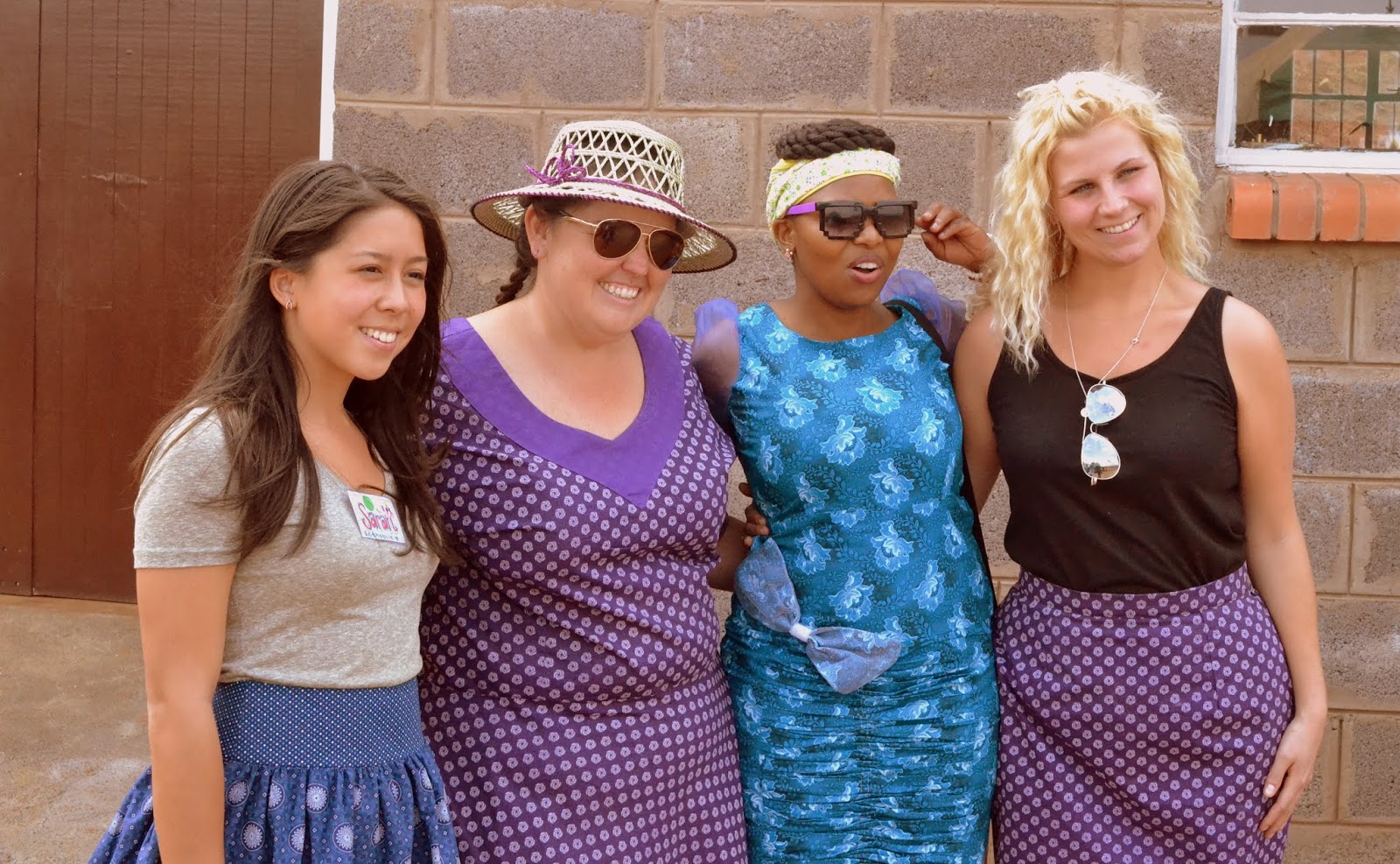
Some of the GLOW 2015 Leadership Team:
Sarah, me, Pontso, and Megan at the end of camp.
I first met Pontso in 2014 at Camp GLOW [Girls Leading Our World]. I was immediately drawn to her enthusiasm when addressing the campers during a career panel. She passionately spoke about getting her Masters in Sociology and the challenges she had overcome in her life to get to that point.

Over the next year, we worked together regularly on the planning team for the 2015 Camp GLOW. She was invaluable in ensuring the most vulnerable girls were included in camp and that we created the most dynamic and applicable topics. During camp, she again blew me away with her readiness to help out in every way imaginable, on top of taking care of her own responsibilities.

Since then, we have transitioned from work partners to friends. It has been fascinating to follow her journey. She is a manager with the Ministry of Social Development. She has applied and been accepted to multiple international programs including participating in the World Festival of Youth and Students in Russia last year, was a 2017 Young Global Changer chosen as part of The Think Summit in Germany, the African Union’s Youth Volunteer Corps (like Peace Corps but for countries in the African Union), and most recently the US’s Mandela Washington Fellowship which is the top opportunity through the US State Department’s Young African Leaders Initiative started under the Obama Administration. She was also honored as one of Africa's Brightest Young Minds in 2017! 
A recent newspaper article about Pontso's volunteer development work. 


In addition to these great opportunities, she continues to volunteer her time to improve the lives of Basotho people. When she was living in Masuoe, an area on the outskirts of Maseru, she became passionate about the impacts of climate change on the local environment. Even though she has moved from that community, she is working with community members, empowering them to work to improve the impact of soil erosion and safety on their community. 


LERATO

Lerato and I goof off together
after teen club in 2016. 
Lerato works at Baylor College’s Pediatric HIV Clinic, where she provided support to patients and coordinates the Teen Club Support Group for HIV positive youth. She is a firecracker of a young woman. At teen club, her bond with the members of the club was constantly evident. She challenged them in positive ways to embrace their situation and take responsibility for their own health.

In addition to being great at her paid job, Lerato is also an outspoken HIV+ advocate. She regularly gives talks around the country sharing her own story and challenging stigmatization of HIV. She was first diagnosed with HIV in 2007 as a teenager. When she shares this story, it’s hard. She does not shy away from her mother’s negative reaction and the loneliness and isolation she felt when she first found out she has HIV.

Voting via SMS for the Finite Awards will finish before the
Ceremony and Gala in August of 2018. 
Thankfully, her story does not end in 2007, with heartbreak. Lerato is a strong and healthy woman. She adheres to her Antiretroviral Therapy. She and her mother repaired their relationship. She has twin daughters who are now seven and HIV negative as a result of successful Prevention of Mother-To Child-Transmission. She uses her experiences and challenges through motivational talks and to help the teens she counsels and supports. 

Last year she helped organize a large and unique HIV testing event. It involved a fun walk, motivational and educational speakers helping to de-stigmatize HIV, HIV testing, and lunch. Almost four hundred people participated in the event with 154 being tested for HIV. 

This year, she is a finalist for the Survival Heroes category of the annual Finite Women Appreciation Awards, which is an award offered by Finite Magazine in Lesotho to women. I, for one, definitely think this is a well-deserved nomination and wish I was still going to be here to attend the Gala with her in August!

LINEO

Lineo and I strike a pose in traditional and modern
cultural dress at the Cultural Day she organized.
I met first met Lineo because she was a counterpart for my fellow volunteer, Nick. She is a faculty member at Leribe Agricultural Skills Training Center. In addition to this, she is incredibly active in the community. She planned and coordinated a huge Cultural Day for the school and local community in 2015.

Last year she qualified for and participated in a regional YALI [Young African Leaders Initiative] Summit in Civic Leadership. She has made the final rounds for the Mandela Washington Summit twice in recent years. Currently, in addition to working to improve agricultural efforts and food security if rural areas of Lesotho; she also spearheaded a project called Barali (daughters in Sesotho).

Barali is a project to decrease school dropouts due to early pregnancy. Working with local Child and Gender Protection officers, she visits area schools to teach young women about their sexual and reproductive rights ad HIV. As she gets to know the young women at specific schools, she works with local leadership to combat the challenges these young women face such as early marriage, gender based violence, etc.

Through Barali, she is fostering dialogue, working with many local partner organizations, and empowering adolescent girls to have the confidence to make their own decisions. She held an event in May to encourage girls to be bold enough to buy their own condoms; something most young women in Lesotho are hesitant to do. Over five hundred local youth participated in the event.

I cherish the moments we steal to reconnect
now that we live further apart. It is always
inspiring to hear what Lineo is working on. 
Currently Barali is hosting a campaign called “Hear My Story” which is sharing stories about women who have had abortions. Abortion is illegal in Lesotho, so women and girls who feel they must have one typically do not have them done by medical professionals. They are often dangerous and lead to medical complications. Seeking medical care after an illegal abortion can also lead to prosecution. The effort of this campaign is to highlight the challenges, stigma, and desperation that women and girls encounter as a result of becoming pregnant.

Even Lineo’s facebook page has become a tool for discussion. She often starts conversation about the impact of perceptions on our sexual health. It’s truly amazing to see the way she fosters important dialogue about culturally sensitive topics on social media.


Monday, April 23, 2018

Homecomings


After a long day of travel and work with herd boys, my colleagues drop me off in the rural village that Peace Corps currently uses for trainings. As I walk to my home for the night, villagers greet me by name and excitedly ask about my life and work. When I reach the house, the family comes pouring out; giving me hugs and talking over one another to welcome me home.

Over the last two years, I have lived in this village for approximately twelve weeks. I have lived with this family for only four of those weeks. Despite this, returning to such warm and personalized greetings feels like a homecoming. Somehow, my return to this village, which has never actually been my home, gives me a greater sense of belonging that the village I have been living in for nearly eighteen months.

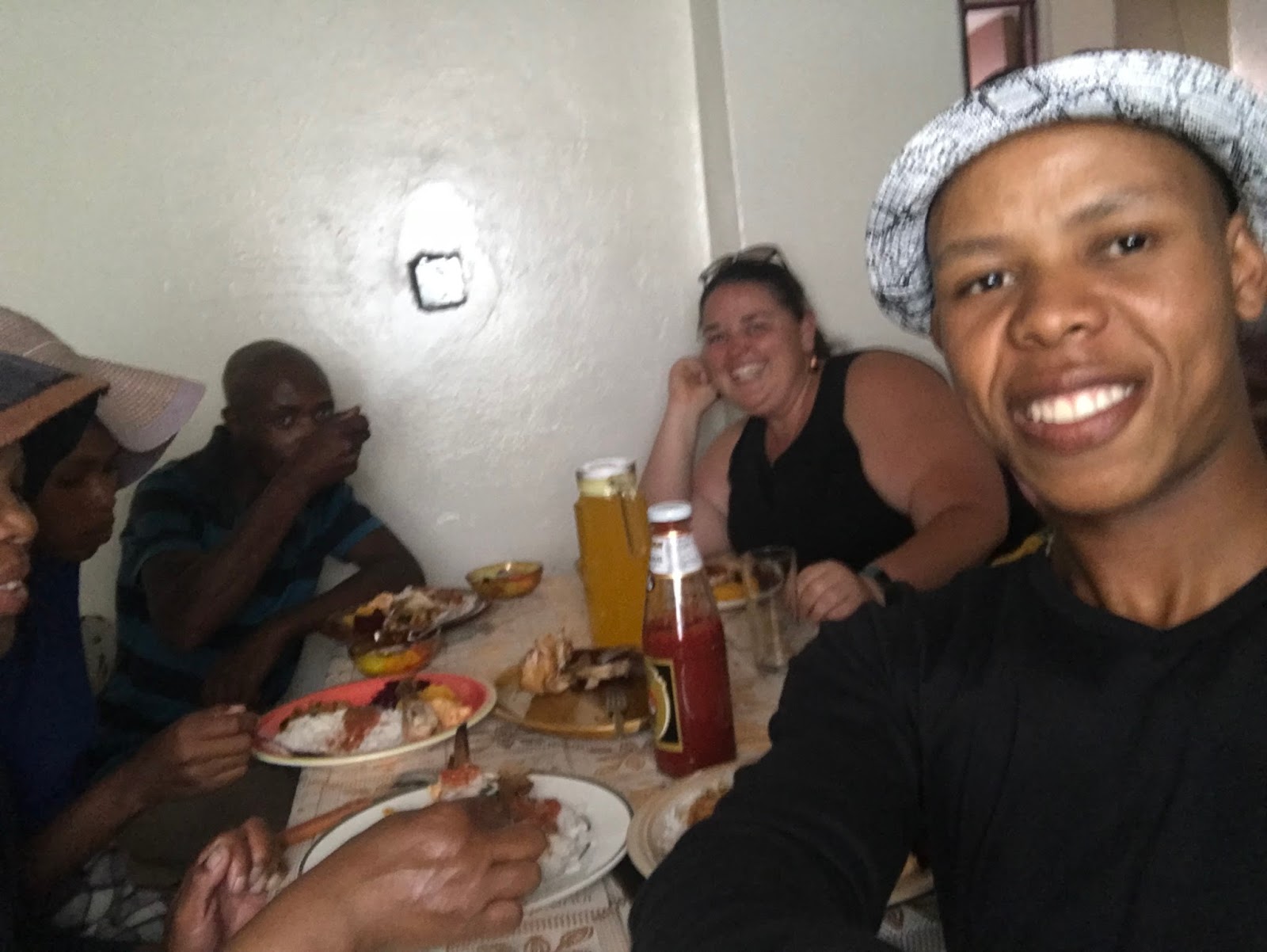
Christmas Dinner 2017 in Ha Rasekila with my Basotho Family
It reminds me of returning to Ha Rasekila for visits and holidays. After a month of challenges and feeling disconnected in my own village and community, this homecoming reminds me exactly why I fell in love with this country.

The Basotho are some of the most genuinely welcoming people. They are quick to welcome and adopt visitors-foreigner or not. One of the first statements said to a guest is always “Rea u amohela” or “We welcome you”. But the Basotho welcome is not limited to words.

When you arrive early for a wedding or a funeral, you are immediately given a plate of food to tide you over until the meal that follows the (lengthy) ceremony.

If you compliment someone’s clothing, they tell you they will give it to you.

And, when you stay somewhere for a while, they claim you as their own.

I will always cherish the moments in the taxi rank when a man would come to hit on me and my villagers would immediately shut him down, telling him “Ke morali oa rona!” or “She’s our daughter!”

As I prepare for my close of service later this year, I cannot help but think about the idea of home, belonging, and how these are defined. As I have struggled with feeling connection in my current village, it has been glaringly obvious that home is not simply the building one lives within. My rondavel is my sanctuary, but that does not provide the connection and sense of belonging that makes a home.

Home is walking into a place or community and being welcomed by people who know and love you.

Home is watching infants become toddlers and children become teenagers.
My favorite twins-they weren't walking or
talking when I first met them, but now they
are quick to talk and play and will enter
preschool next year! 

Home is knowing the paths around you so well that you can observe them changing over time.

Home is connection to people and the place.

Home is where you return to for holidays like Christmas and Easter.

And, home is hard to leave. In less than three months, I will finally close my Peace Corps service and return to my country of origin. I am excited to return to the US and make a new home outside of Santa Barbara, California, where I will be teaching English at a residential boarding school.

Saying goodbye to the relationships I have made in Lesotho, however, fills me with dread. Luckily, Lesotho is now one of my homes and I know that this goodbye will not be forever. 

Tuesday, April 18, 2017

Easter Reunions

Family Photo-Mme Masekila, Abuti Mokhesuoe, Abuti
Thabo, Abuti Polau, and me. We are only missing
Abuti Sekila and my replacement, Ausi Mosa.
People often say you can’t go home again. In December, I stared at the familiar Boston skyline as my plane landed and agreed. After being gone for the last two and half years, people felt like home, but America did not.

Friday, however, I disagreed profoundly. The moment I got out of a car in Botha Bothe, a man greeted me by name. As I shopped for food, people did double-takes, exclaiming when they realized it was, in fact, me.

Once I finally made it to my village—after a three-hour wait for a taxi—the homecoming really began. Within twenty minutes, I had seen my supervisor and another woman I worked with, two of my best friends and my mother. Everyone greeted me with joy, hugs (These are not typical, which only made them even better), and celebration. As my mother and I walked home, people stopped us to comment on my return and to be sure I remembered them after my four and half months away.

Sunday, January 08, 2017

Saying Goodbye Part 2

My host mother, 'M'e 'Masekila and me before the ceremony.
My host mother comes to the door in her red Seshoeshoe dress. I immediately stop what I am doing, “’M’e, U motle hakahang!” (Mother, you are beautiful right now.)

“Che, ausi Thato, re batle hakahang,” she replies. (No, ausi Thato-that’s me-we are beautiful right now.)

We grab our things and head out the door, walking through the village together. As we approach people, my mother ululates loudly before we begin the customary greeting process. After our greetings, before they can ask, she proudly tells them that we are going to a party for me because I am finished my work.

As the community building and chicken house come into view, I see Bo-‘M’e busy bustling around outside. Then, the ululations begin in chorus, calling everyone to see that I am coming. As we get closer, these incredible grandmothers I have been blessed to work with begin singing and dancing towards us. They surround us and sing for me before guiding me to continue on into the hall. They parade behind me, still singing until I sit down at the table in the front of the room.

I look out at the empty chairs and chuckle to myself. Two years ago, I might have thought that nobody cared, but now I know better. Village ceremonies never start on time. My mother and I were over an hour late. Everyone else now knows to come because of the volume of our arrival.

I sit in the seat of honor and look at the space that has seen so much of my work. Along one side of the room are fifty bags of chicken feed, awaiting the very late arrival of our chickens. Dotted all over the white ceiling are dirty imprints of the soccer ball we used for the Grassroot Soccer HIV programs I did with teenagers. I can look at the chairs and identify by color whose house each one came from. It is surreal to realize the time to say goodbye has finally arrived.

Soon the room is full enough that Bo-‘M’e and the chief decide to start the ceremony. Ceremonies in Lesotho all follow the same structure. First, there is a short hymn followed by a prayer. Then, the MC, in this case, ‘M’e ‘Majustice introduces themselves, the purpose of the event, and explains how the ceremony with proceed. From there, the MC invites various individuals to speak about the person or topic for the ceremony. In between each speaker, the MC announces the next speaker and then everyone joins in singing a song as the speaker comes to the front. At the end of the ceremony, instructions for the meal are given, a prayer is said, and the formal portion concludes.


Monday, October 31, 2016

Hardship Hits Hardest at Home

My suddenly very adult brother,
Abuti Thabo, at the mine. 
I stare at the screen of my phone and blink back tears of frustration and anger as I reread my brother's text message: "I miss you too my sister. I don't think I will come for writing [my exams] because they are disallowing me to come write."

One week before receiving this frustrating text, I had been sitting in the hall at my brother's school; beaming as he received the Leadership Award. Now, I am sitting in that same hall doing Camp BRO. I am forced to be on my game-inspiring young men to be positive leaders for social change-when all I want to do is mourn the future I imagined for my brother.

My amazing and inspiring brother will not be completing secondary school at the end of November as planned. He will not be writing the intense Form E exams to earn his certificate—the Lesotho equivalent of a diploma.

Instead, he is now an employee at a platinum mine in South Africa; taking on the job his father held before his untimely death a decade ago due to “mine-related illness.” Because the mine acknowledged responsibility for his illness, they have been holding a position for my brother for the past decade.

Thursday, September 01, 2016

Three Photo Thursday: 1 September

Spring is coming! The first recognition of this is already blooming beautifully in our yard: plum blossoms. The plum tree is always ahead of the peaches. It blooms weeks before them, with delicate and beautiful white blossoms. It also produces a month or two ahead of our peach trees. While Lesotho will soon be filled with bursts of pink color on the brown landscape, these white flowers are the first indication that winter is ending.

Considering how cold the weeks preceding these little flowers have been, I am really excited to see them bringing in warmer days!


I tried to pick the least gruesome photo to show this moment.
The week started out with our “pet” pig being slaughtered. This pig had been free range since winter began and there were no gardens to be destroyed. He had reached the point of trying to heel whenever we wandered around the yard or started out from the house. I am still not sure he realized he was a pig and not a dog, especially as he had a tendency to come running to kiss my leg every time I left the house.

This Sunday morning activity was not my first pig slaughter, however, it was the first time we slaughtered something larger than a chicken at our house. The boys and their uncle spent much of the morning working with the pig and later the meat. I then spent much of the later afternoon cutting up my portion of pork to make Five Spice Pork Tacos! Since I never cook meat at home, this was quite the treat!

Chatting it up with the amazing Lebo Mashile after her
inspiring poetry reading in Maseru. 
Throughout my 27 months in Lesotho, my cultural moments have been restricted to the local culture found in rural villages. Celebrating and learning traditional culture through Cultural Days or incredible moments like being thrust into the Litolobonya hut has been amazing. This week while in Maseru to help with preparations for the upcoming Pre-Service Training, a good friend invited me to attend a Poetry Festival.

Although excited, I was ill prepared for just how much I would love the experience. It was like coming home while still living in Lesotho! The night began with some young women performing their own poetry, switching comfortably between English and Sesotho while blowing me away with their stage presence. The headliner, Lebo Mashile from South Africa, really astounded me.


The month of August is women’s month and as such, Lebo performed a number of her poems centered around the realities of being a women. With lines like “Tell your story until your past stops destroying your future” and “There is a me that I could be, if I just let her breathe outside,” I found myself hanging on her every word. My friend and I had the chance to meet her after the show, where she admitted that this was the longest reading she had ever done. We very truthfully assured her we would have happily listened to her for another hour or two as she signed the book of poetry I had quickly purchased. The long forgotten English major in me ecstatic to delve further into the way that Lebo plays with words, meaning, and rhythm. 

Monday, August 15, 2016

Boys with Toys

I have been promising this mini-adventure for over two months. The combination of too windy days, cold, and a busy schedule have meant that every time my youngest brother knocks and asks if today is the day, I answer with a maybe or a no.

This morning I wanted to continue the trend. After three weeks with no down time, I really just want to hide in my house. I do not want to go out and play when I finish working today.

But, my host brother’s earnest face as he tells me it is not too windy and my own guilt spur me into action. I assure him that we will go fly the kite after I get home.


When I was traveling in the Caribbean, I was always impressed by the ingenuity of children. Many boys used plastic bags and sticks to create colorful kites. Although the children here are equally creative, kites have not been included among the many wonderful toys I have seen created over the last two years. As a result, my brother is enthralled with this small colorful kite my friend Jen sent me.

He has no idea what we will do with it; just that it is shiny, flutters on its hook when we open my door, and that I keep saying it cannot be too windy when we play with it.


He eagerly skips ahead of me as we head out to an open space not far from our home. The next oldest brother is planning to join us, but I know that Abuti Polau is excited to be the first to play with the kite.

Although the wind is intermittent, we are able to get the little frog (less than four square inches) flying after only a few attempts. The kite’s long blue tails dance in the wind as my brother learns to feed it string and take the string in when the wind speed dips. As Abuti Polau becomes an expert, our sixteen-year-old brother joins us. Not surprisingly, he also figures out how to work the kite in no time at all.

Purchased toys are rarely seen in my village. Most children are able to get creative. I have seen wires turned into cars, a homemade guitar, and pieces of cardboard turned into sleds on the grass. I am always impressed by how little the kids around me need fancy plastic toys shipped from China. Their creativity in turning things into games and toys always impresses me, especially when compared with all the toys we grow up with in America. 

That does not, however, diminish the fun in sharing a new toy with my brothers! 


Tuesday, July 19, 2016

Chicken Coop Construction: Day Two

The walls are growing, albeit more slowly than any of us anticipated. Building started “on time” at nine, but the first few hours were a methodical exercise in precision as the two lead builders checked angles and levels repeatedly.

Once the base layer was in place, the pace picked up dramatically. The next three layers of bricks taking the same amount of time as the first one.

Abuti Sama cuts the plastic to
the correct size.
The glitch of the day was minor. I was asked for the roll of black plastic that acts as a moisture barrier. I proudly pulled out the giant 3m by 30m plastic we bought…only to learn the hundreds I spent was for naught; I should have purchased a roll of 15cm-wide black plastic for less than fifty Maloti.

The miscommunication showed itself as my friend and I discussed what he told me before I went to the supply store. When he described the plastic, he said it was “for the floor” so I bought enough to cover the entire floor. What was actually needed was to go around the edge of the floor. Out came a hacksaw and we cut the edge of my giant roll to achieve the needed dimensions. Internally I lamented the waste of money until my friend told me we would use the plastic on the floor too, since we have it.

At lunch time, the man building out chicken cages delivered. They do not look like much yet, but he will return in a few weeks to install them with feeders, drinkers, and tubing to fill the drinkers.

Watching the precision and craft that went into making everything level and strong, I feel much better about paying the builders today.

I spent the day trying to help. Women do not typically help in construction, so my efforts were not always encouraged. The guys, most of whom are my friends and one is my brother, would tease me until I jumped in to load, unload, or carry the bricks. Then, they would stop me, telling me I am strong my hands are too soft.

Sometimes I wish these guys could have seen me sail. 


The chicken coop at the end of day two.


MCCC’s Egg Laying Chicken Project has been in development since March 2015. After many delays, MCCC and I were able to write a successful grant proposal for a VAST grant through Peace Corps. VAST grants are funded by PEPFAR to help with HIV-related work and OVC (Orphan and Vulnerable Children) care. It is due to MCCC’s work with OCVs that qualified us for the VAST grant. Otherwise, we would have applied for a PCPP [Peace Corps Partnership Program] grant and would have been asking for assistance in funding this grant proposal. I encourage you to consider supporting other PCPP projects.

Posts about this project include:
Workshop Woe, Busiest of Birthdays, Checking Out Chickens, A Day with Bo-’M’e, Chicken Coop Construction Day One, Day Two, Day, Three, Day Four, Day Five

Saturday, July 09, 2016

Indian Prayers

In early January, I posted a hugely popular post about Natasha and Prien’s Wedding. I intentionally omitted a key aspect of the wedding: the fact that neither Natasha’s mother nor father were present.

Despite the joy the wedding presented, there was a somber note as well. Every time that reference was made to the bride’s father, shadows passed over the faces of all in the ceremony. Natasha’s father had passed away only six days before the wedding.


As a result, my lessons on Indian wedding traditions included a brief foray into Indian funeral traditions. For example, much as there are a series of rituals that occur in the week leading up to a wedding, there are a series of prayers held on specific days following someone’s death. While Indian weddings are brightly colored affairs, white is the color of mourning.

And, much like Basotho grieving customs, the wife of a deceased man must stay home until the first series of rituals have been concluded, in this case, sixteen days, which is why Natasha’s mother was also unable to attend the wedding.

Natasha’s father, George, had been sick and while he was hoping to survive to attend the wedding, he had also been adamant that the wedding go on as planned. As a result, the couple honored her father by moving forward.

The more I learn about Indian culture, the more I appreciate it. Much like in Basotho culture, grief does not end at the conclusion of the rituals in the first sixteen days. There are specific moments throughout the following year for prayers. In June, my dear friend Venilla invited me to join her family for the six month prayers following her husband’s death.

At Venilla’s request, I arrived early for the prayers with my sari in tow. We finished working in the kitchen, preparing the food for the prayers while laughing together. The meals for the prayers are all vegetarian, to maintain mourning.

As we finished cooking, the oldest daughter still at home set up the ritual area. It included a variety of foods for her father, incense, and flame. We changed into our outfits and began the prayers.

I remembered from the wedding that the ritual area is sacred and therefore we approach barefoot-a cold task in Lesotho’s winter months! Starting with Venilla, we each took a turn kneeling and saying prayers.

As we finished, we left the room so that the deceased could come and eat the food laid out for him. It would remain there for a few hours and would be sprinkled with water before being cleared.   
 As we transitioned into the dining room to dig in, our somber mood was released and we celebrated dining together. As usual, Venilla insisted I eat more food than I could manage and her children kept us all entertained.


Finally, just before sunset, after too many photos and too much food, I headed home, filled with joy at being included once again as a part of the Naidoo family, even in the difficult moments. 

Friday, July 01, 2016

Ho Lila: Basotho Home Maintenance

It is early on a cold Sunday morning. Unlike most women in our community, my host mother and I are not getting ready for church, doing laundry, nor warming ourselves in the sunlight.

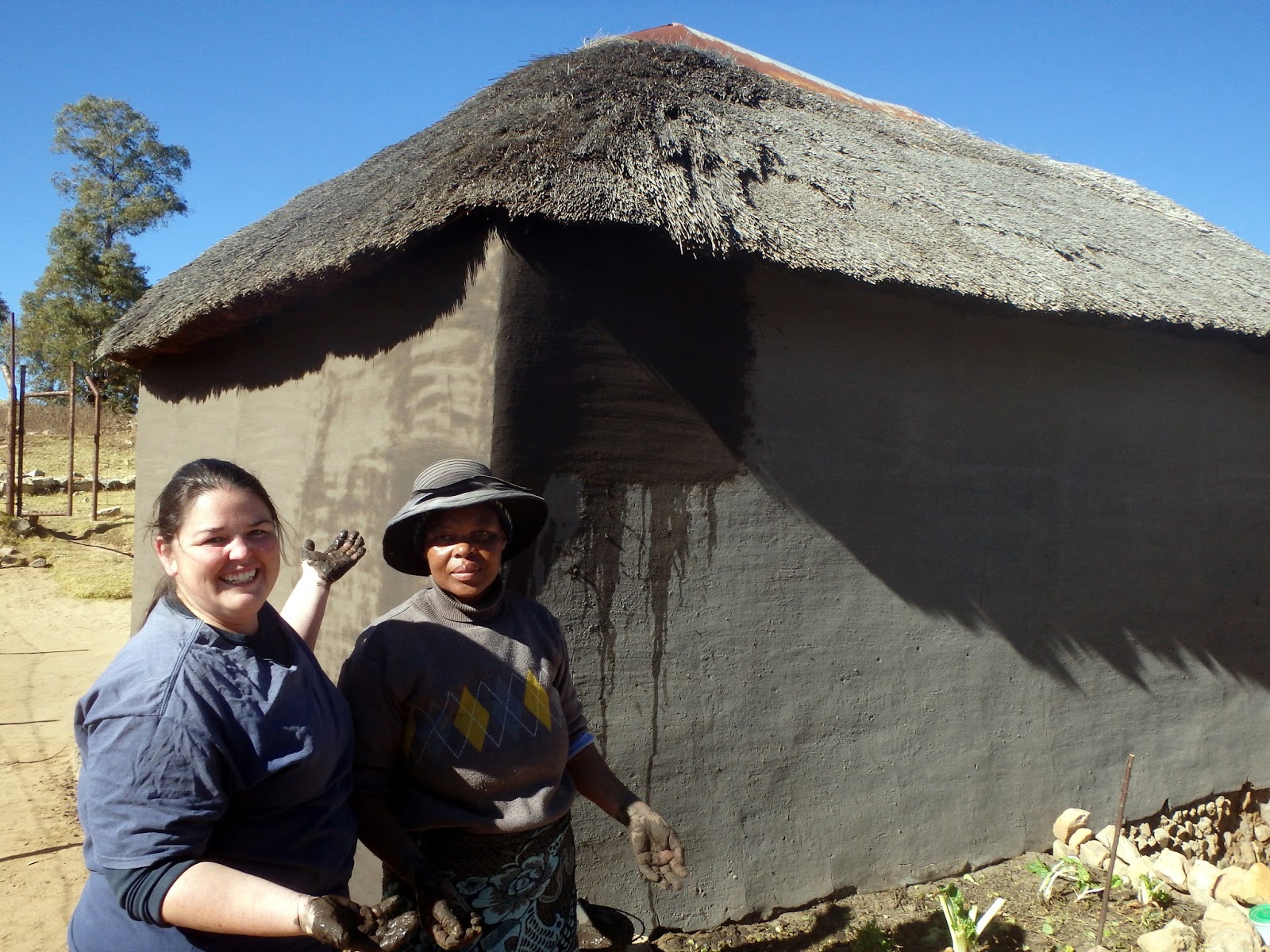
Instead of the usual Sunday morning activities, we are using our hands to mix mobu (mow-boo). My As we mix it, my mother explains in Sesotho that today our mobu is a combination of makaka a likhomo or cow dung and water.

Once the chunks are crushed and the mobu is well mixed, she climbs up on a bench and begins smearing it in large sections on the outside of my house.

My house, a heise (hay-see), is the rectangular variety of traditional Basotho dwellings. It is made of rocks and cow dung with a grass roof. This makes it well insulated against the winter's chill and the summer's heat. It also means that every year or so, it requires another layer of mobu to keep it from decomposing.

We have not added any mobu since I moved in two years ago and the cracks that develop as the house bakes in the sun are a sign that it is definitely time for a fresh layer.

She demonstrates the process for me by first smearing a thick layer of dung in a square section at the highest corner of the wall. Once coated, she sprinkles water on the section and uses her hand to smooth it out. She explains that using thin, smooth coats of mobu is considered a fine finish. Others put on a thick layer and they use their fingers to create designs, however, "rough" layers do not last as long as fine layers.

To offset the cold temperatures and cold mobu, we are using heated water. Our fingers appreciate the difference.

Once the first tema (tay-ma or section is complete, she climbs off the bench and demonstrates on the section just below it. After it is complete, she lets me try on the lowest section. When it is time to smooth the mobu, she shows me how to blend the edges between her section and mine so that the finished product will be smooth.

Again, she does the upper two sections and I do the lowest one. As we begin the third column, I offer to start on the middle section after she completes the upper one, however, she instructs me to wait and do the bottom. Without her saying so, I realize that as the beginner, I am doing the least noticeable sections so that when people visit the Chief, they will not think that we lila (dee-lah) poorly.

As we round the first corner of the house, my mother tells me I can do the middle or eye level sections. Despite having only done four sections in my entire life, I feel a great sense of accomplishment at this achievement. After each section, my mother tells me my work is beautiful.

We talk as we work. She tells me that girls in Lesotho all learn how to lila from their mothers so that they are prepared to do it when they marry. There is no way to know if a girl will marry someone with a traditional house, so it is important that all girls know how to maintain them. She laments the loss of culture that comes from girls being raised in town and therefore not learning how to lila, asking what kinds of wives those girls will be if their husband is from a rural place. She celebrates that I am eager to learn and I cannot help but think about how difficult it must be for this incredible woman to have only sons and therefore have no one to teach the traditions to.

Soon, my host mother is teaching me how to use the harder, drier mobu for patchwork around the bottom of the house. The lowest part of the house has rocks stuck in the mobu to help prevent rain and mice from damaging it. Last year, our pig created a game of trying to loosen the rocks around the bottom of my house, so there are a few spots that need big patches made.

It is the middle of the afternoon by the time we complete the third side of the house. The fourth side is for another day as it is a different color. My mother explains that she will use makaka a lidonki le lipere or donkey and horse dung to make that mobu; which is how it gets a nice orange color instead of the gray we have been using.

She shows me how the window and door frames are done. They are much trickier, so I am reduced to being an observer. As she does them, she explains that it is a much slower job to lila inside the house. It requires moving furniture and far more work at keeping things perfectly smooth. We are not doing that right now, as it is painted and gets damaged by the sun far less. I do ask her if the process for patching is the same and consequently learn how to fill in the mouse home made last year.

We begin cleaning up. I am, as usual, impressed at her ability to be elbow deep in dung all day without getting particularly dirty. While mobu was dropping the entire time we worked, her feet and pants are mostly clean. I, as usual, am not.

Before we finish, I thank my mother for showing me this traditional method and letting me help her. I am sure that teaching a beginner has slowed her down. She, on the other hand, thanks me profusely for helping her. She tells me she would not have finished until six or so without my help. I am grateful that my joining her for this unique experience has actually been helpful.

More on homes in Lesotho can be found in Constructing Dreams, Thatch to Patch, and Heise Sweet Heise.

Friday, June 24, 2016

A Day with Bo-'M'e*

The chicken project is finally starting. In reality, the project started over a year ago, as mentioned in Workshop Woe and CheckingOut Chickens. But, as of this week, there is visible and financial proof that things are happening.
Coming soon to this spot: MCCC's Egg-Laying Chicken House!
Construction begins July 2016!
Monday, we met with two representatives from the Ministry of Agriculture, who simply wanted to make sure that we had everything lined up. Then, on Tuesday morning, I trotted off to town with my counterpart, Ausi Mareisi, and two of the leaders in our group, ‘M’e ‘Matokelo and ‘M’e ‘Majustice.

Our first stop was the bank, where I withdrew half of the fund from our Peace Corps grant. Then, we headed to the store. Although we had our original quote, we had a few things to add to the shopping list so it took a few hours to complete our purchase. During the many long waiting times, we joked and laughed together while sitting on comfortable couches in the cold store.

Once we had paid and had the smaller items, we headed down to the loading area. Boloka was nice enough to give us free transport of our goods, but as we sat there half a dozen men with trucks approached us asking for the opportunity to transport our goods. Normally I get frustrated when people ask me for jobs as it is simply because they see my translucently white skin and assume that I have jobs to share. In this case, however, it made perfect sense as I obviously had not vehicle and had purchased large goods.

Watching them load 30 bags of cement.
While we waited…and waited..and waited for our goods to get loaded up, Bo-‘M’e grabbed the four of us lunch from a roadside vendor. We sat in the sun to stay warm while eating our meals amidst cement dust and a dozen men walking back and forth with building supplies.

Finally they began loading a truck with our goods. While three of us observed, a man came by and asked us for the job of unloading the thirty bags of cement he could see already loaded. ‘M’e ‘Majustice started by telling him that we did not have money to pay him. He tried bargaining with her, changing his offer from 80 Maloti to 70 to 60 and finally to only 50 Maloti. When she repeated that we did not have money to pay him, he transferred his attempts to me. I repeated the same things she said. He quieted for a bit before trying again. As frustration set in, I elaborated, explaining that the supplies were for a community project so we did not have money to pay people for labor. He immediately changed his tune and wished us luck. After he walked away, ‘M’e ‘Majustice quietly observed, “He must be very hungry, to do this much work for only 50. He is hungry.”
Still loading our supplies...almost done.

Throughout the loading process a number of younger men came up offering their strength to unload our supplies. None of them was willing to do it for less than 70. Each time I listened to ‘M’e ‘Majustice talking with them, I felt guilt over the hungry man. Although I remained polite externally, I had been frustrated by his persistence, not even reflecting on how disproportionate the work he was offering to complete was in comparison to the money he would accept. Days later, I wish I had simply accepted his offer and paid him out of my own pocket.

Finally our goods were ready. We learned the driver could only take one of us with him. After some discussion, it was agreed that ‘M’e ‘Majustice would go with him and that they would make a quick stop to purchase the trucks of sand we would need to mix with our cement. I gave her the money for the sand.

Ausi Mareisi, ‘M’e ‘Matukelo, and I then headed to the taxi rank, getting completely sidetracked. In front of one of the shops near the rank was a performer rapping and dancing. We stopped and watched the show, dancing and laughing together, until our taxi driver spotted us. He came over and told us there were only two spots in the taxi and he wanted to leave so we better get going.

Unloading the supplies
Thankfully, when we arrived, there were exactly three spots for us to take up and off we went. When we arrived at the community building, a handful of the women in MCCC were there. They had spent the day cleaning up the tall grass around the building while awaiting our delivery. Four men were unloading all our goods: three from Boloka Building Supply and one from the village. MCCC “tipped” the men from Boloka the same amount that we would have paid the man who begged us to hire him.

After the truck left, the women and I surveyed the goods in the hall. The women were thrilled that things are happening. They kept thanking me as I kept trying to say it was not me, but their efforts and work that made this happen. We finally agreed to disagree as we locked up the building.

As I walked away just before sunset, I marveled at what a productive day it had been. Other than the woman who worked with us at the building supply store and occasional conversations with Ausi Mareisi, I had completed an entire day in only Sesotho. We had bought our building supplies and sand. I had arranged to pay the deposit for our cages. While I had started the day thinking we would also buy the cement blocks for the house, time had not allowed it, so we had rescheduled that for later in the week. After a long day out and about, I was excited to head home and excited about our project taking shape.


*Bo-‘M’e:. ‘M’e means mother and is the title given to all married women. It is made plural by the “Bo” preceding it, so in this case it means more than one woman or mother.


MCCC’s Egg Laying Chicken Project has been in development since March 2015. After many delays, MCCC and I were able to write a successful grant proposal for a VAST grant through Peace Corps. VAST grants are funded by PEPFAR to help with HIV-related work and OVC (Orphan and Vulnerable Children) care. It is due to MCCC’s work with OCVs that qualified us for the VAST grant. Otherwise, we would have applied for a PCPP [Peace Corps Partnership Program] grant and would have been asking for assistance in funding this grant proposal. I encourage you to consider supporting other PCPP projects.

Posts about this project include:

Workshop Woe, Busiest of Birthdays, Checking Out Chickens, A Day with Bo-’M’e, Chicken Coop Construction Day One, Day Two, Day, Three, Day Four, Day Five

Tuesday, June 21, 2016

Failure to Adapt: 4 Cultural Things that Challenge Me

After more than two years in Lesotho, there are many aspects of Basotho culture that have become a part of my own identity and tradition. I absolutely love living here, as evidenced by the procrastination of My Peace Corps Service Conclusion. There are, however, times that the American inside me struggles with specific cultural norms...even when I understand them...even when I know where they originate from...even when I respect the. Here are a few norms in Lesotho that are so vastly different from my own past that I simply cannot seem to overcome them:

Here my Grade 6 Life Skills students sing for me, but
they have also insisted I stop teaching to answer my phone
when I forgot to turn the ringer off before class.
1. Interrupt Please!
I know and understand this. I do not take offense when someone interrupts our conversation for a ringing phone or to greet someone passing by. At the same time, every time I walk by a friend engrossed in a conversation, I have an internal battle between being a rude American and butting in with a greeting or being a rude Mosotho and walking by without saying hello. Every time I have to force myself to choose Basotho culture and interrupt with pleasantries. Every time.

2. Just Ask
As I explained in Motho Ke Motho Ka Batho, the cultural belief in Lesotho is that people are here to help one another. As a result, it is completely acceptable and even encouraged to ask people for what you need or want. Out of matches or salt, pop next door and ask for some. Need something from town and a neighbor is going, just ask. Hungry or thirsty after a long walk to another village, just pop into a random home and ask for food or drink. Traveling but not reaching your destination in a rural village before nightfall, just ask for a place to sleep.  The generosity and caring people show for one another is one of the most beautiful things about Basotho culture and tradition.

In America, however, we are staunchly independent. If we can do it ourselves, we should and do…especially in northern New England. Our Yankee Pride means we can barely accept help when it is offered and we never ask for it. When I first arrived in Lesotho, I struggled with people asking me for things. When people arrived at the Chief’s place, tired and thirsty from travel, I bristled that they felt it acceptable ask me for a glass of water when getting water requires work. I finally adapted and am comfortable sharing things as small as matches, salt, or water. I still struggle if someone asks me for food as I cook only enough for myself. And no matter how hungry or thirsty I get, I never ask for things.


This man insisted on a photo with me before assuring
me that he would be an excellent husband. 
3. Wife Up 
As I mentioned in Love and Marriage and My New Approach to Proposalsa  Mosotho man shows he is respectful and serious about a relationship by starting relationship conversations be bringing up marriage. Almost any time I am outside of my village, some man will say he wants to marry me or he will be my husband. Although I know that this is the polite opening to flirtation, the absurdly independent single woman inside me runs the other direction every time an offer or suggestion of marriage is made. I simply cannot start conversing casually with a man who suggests marriage before asking my name or knowing that I even understand the language he is speaking. 

4. Or at least Dial Up
A more modern version of opening with marriage proposals is to simply insist a woman give her phone number. I have seen men literally hang out of a taxi window and shout, "Give me your numbers baby!" More surprising to American me is that I have also seen women respond by giving the man her number! Once again, if someone starts with something big like a number instead of my name or a casual compliment, I simply cannot deal. I check out of the conversation, my smile becomes fake, and I internally role my eyes. It does not matter that I know this is the norm in Lesotho, I simply cannot wrap my brain around it and I will not be giving my digits this way.  


Friday, June 17, 2016

Blanket Wearing Weather


Winter in Lesotho means it is time for wearing blankets. Actually, Basotho wear blankets throughout the year, however, the blanket game is stepped up in the winter.

Women dressed up for our swearing-in ceremony. They are wearing seshoeshoe dresses and formal kobos.
The Kobo is a large blanket typically worn around the shoulders. Kobos play a significant role in Basotho culture. They are given as gifts at important life moments including marriage, Initiation School, and the birth of a woman's first child. Some designs and patterns have historical or cultural meaning as well. For example, the maize blanket represents fertility.

Men tie their kobo on the side, while women pin theirs in the center of the chest like a cape. For women, ensuring the lines of the kobo are even is of vital importance. Most Basotho have at least one nice kobo for dressy occasions and a number of older, well-worn ones that can be worn to stay warm on a daily basis.
The women in my organization staying warm as we work by wearing their charlies.
 The Charlie is a smaller blanket tied or pinned around the waist of a woman. Typically these are worn by married women-who are no longer to sit without sitting on a blanket and are expected to keep their core warm to ensure a healthy reproductive system. Often, however, when winter arrives, girls also wear them as they really help to keep a person warm.
 
While waiting to be weighed at the outreach clinic, this baby is staying warm despite the winter chill.
Baby Blankets are a year-round part of Basotho tradition-they are used to keep a baby on a woman’s back. In summer months, women will often use thing scarves or towels, but come winter, they utilize the same warm blankets they tie around themselves as a Charlie. Then, once the child is secured, another blanket is often put over the woman’s shoulders, cocooning the baby in warmth and protecting them from the elements. 
Women wearing all manner of blankets for a community meeting. The woman on the left has a baby under the blanket that covers her shoulders. As the sun became warm, many of the women removed their kobos from their shoulders and wrapped
them around their bodies instead.